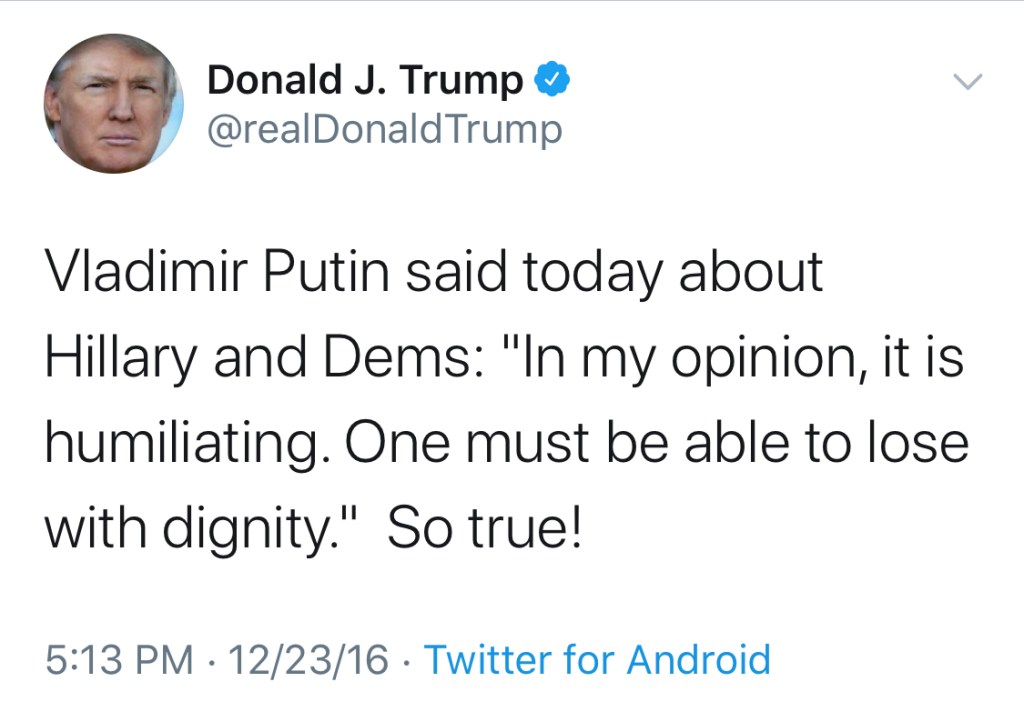
The election is over. Yes, vote counts must still be completed and certified. Yes, the Electoral College won’t vote until December. But it’s over. We know who won. Just like we always know who won before results are official.
I take that back. One time in the past 20 years, we had to wait until December to know who our next president would be. The 2000 presidential election hinged on one state, Florida, whose initial final count had less than 2,000 votes separating the candidates. The recount saw a 1,247 vote change in Al Gore’s favor, but it wasn’t enough.
Still, 1,247 votes changing in a recount is a pretty large shift. Usually, recounts don’t see shifts of more than a few hundred votes. The all-time record for vote shift in a recount is 2,567.
With vote counts nearly finished, here are Biden’s margins in the states Republicans are pinning their hopes on:
Georgia: 10,000+
Arizona: 17,000+
Nevada: 34,000+
Pennsylvania: 45,000+
It’s over.
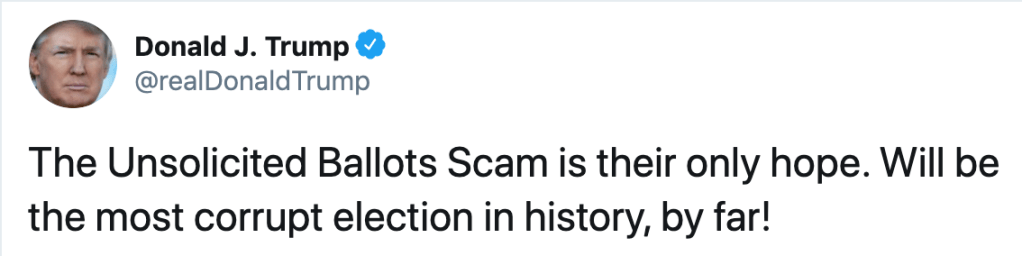
What’s maddening is that if every state had counted mail-in ballots early, like Florida did, the presidential race would have been called on Election Day, and it wouldn’t be seen as particularly close. What’s more maddening is several key states, including Pennsylvania, wanted to start counting their mail-in ballots early, but this change was blocked by Republican state legislatures. Republicans ensured there would be delays in counting votes, then used the delays they caused to claim fraud.
Of course, the GOP is simply following the example of its leader. And claiming fraud is what he always does when he’s losing.
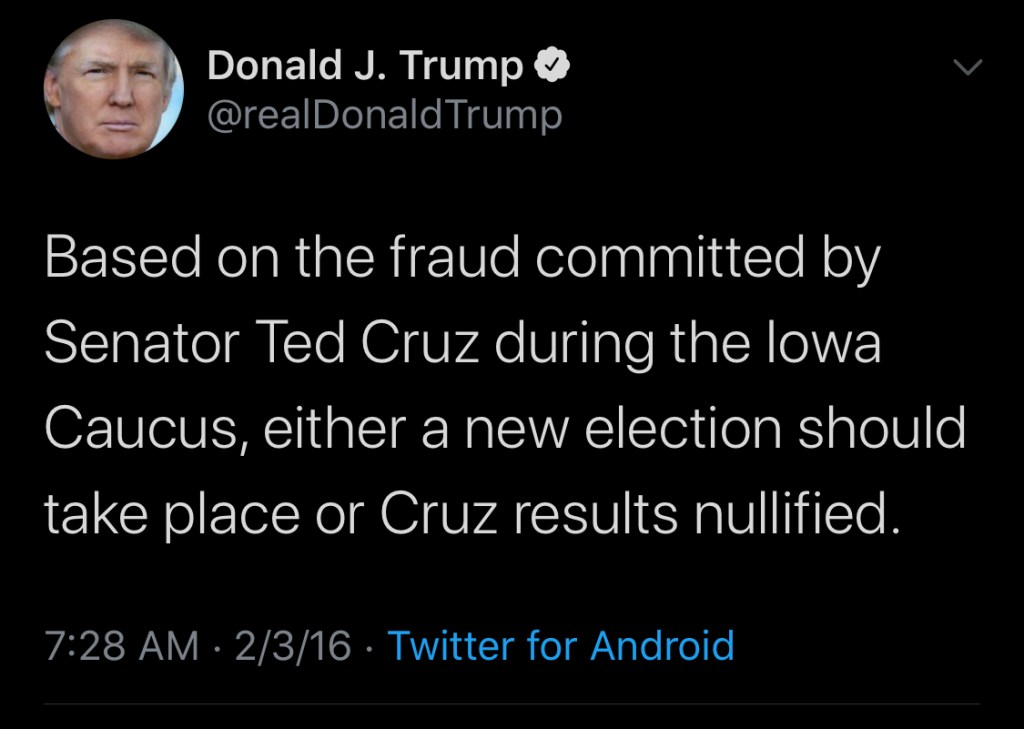
He did it when Ted Cruz beat him in the Iowa primary in 2016.
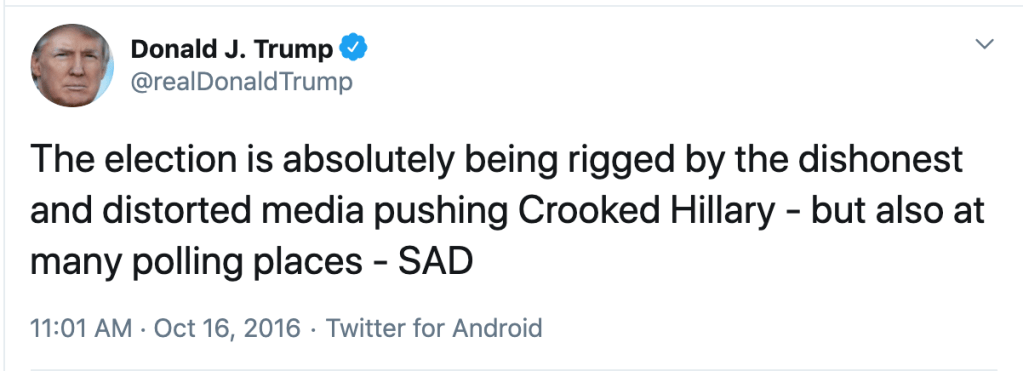
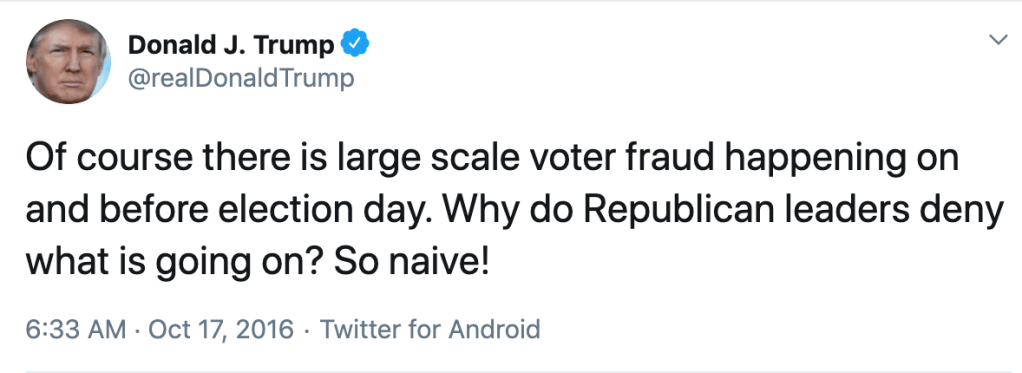
He did it leading up to the 2016 general election, when he and everyone else thought he would lose to Hillary Clinton.
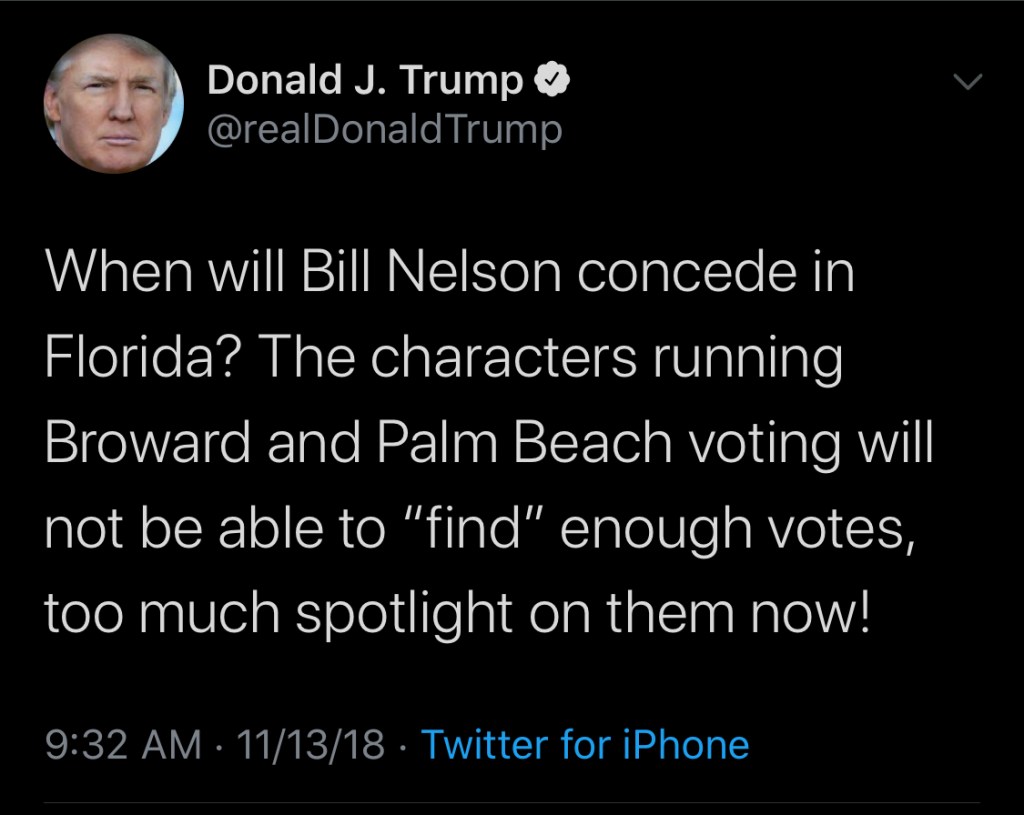
During the 2018 senate race recount between Democrat Bill Nelson and Republican Tim Scott, he taunted Nelson, telling him to concede before the recount was finished, and implying election officials were dirty. (The recount saw an increase in votes for Nelson, but not enough for him to win the election.)
He spent months leading up to this election sowing doubt and suspicion.
What he and his supporters have not explained is why the Democrats, hundreds of poll workers, and election officials who conspired to steal the presidency forgot to also steal the Congressional seats Biden will need to accomplish his secret socialist agenda.
He put out a statement on Saturday morning, shortly after the election was called for Joe Biden, in which he repeated his claims of fraud and vowed, “I will not rest until the American People have the honest vote count they deserve and that Democracy demands.”
Meanwhile, his campaign inundated supporters with fundraising emails, urgently requesting donations for the “Official Election Defense Fund.” The campaign sent at least 17 fundraising emails on Sunday alone. Trump’s official website tells supporters the president needs their money to stop Democrats who want to STEAL the election.
But in the fine print, you can see that 60% of donations will go toward paying off the campaign’s debts.
He primed his supporters to believe the election would be fraudulent. Then Republicans in state legislatures helped drag out the vote counting. And now that he’s lost, he’s going to squeeze his supporters for every dime while he still can.
But they believe in him. I’ve seen so many this weekend who fervently believe it’s not over, that he will still win, that he is fighting hard for them.
Maybe you’ve seen it recently, like I have (over and over and over): James Dobson’s “Final Thoughts about the Election.” I have to write about it; it’s just too much for me to take.
For those unfamiliar, James Dobson is a household name in conservative Christian homes, and has been for decades. His Focus on the Family organization has promoted Christian values and social conservatism since 1977. Dobson has long supported Republican politicians, and wielded significant political power thanks to his wide readership among Christians. The New York Times once called him “the nation’s most influential evangelical leader.”
In his “Final Thoughts about the Election,” Dobson doesn’t directly name either Trump or Biden, but it’s obvious who he’s talking about, and how he wants his readers to vote. He invokes Newt Gingrich, who believes “what we are facing now might bring an end to civilization as we have known it.” Yes, yes, by now we have all heard that if Joe Biden wins, America will be destroyed.
Dobson asks voters how they’re going to decide whom to vote for. Will we be like “dozens” of people he’s heard from, who will vote based “solely on a candidate’s rhetoric, tone, style, or likeability?” Later in the letter he laments that “the notion of choosing a president based on frivolous personality characteristics is so unfortunate.”
Can we pause here for just a second? Because this is something I’ve seen for years, and it drives me up the wall. I cannot tell you the number of times I’ve seen Trump supporters accuse conservatives like me of opposing him just because we don’t like his tweets, or because he’s brash, or because he’s unpolished, or because he’s orange. Because of his “frivolous personality characteristics.”
Anyway. The heart of Dobson’s open letter is actually an anonymous social media post which I’ve also seen making the rounds for weeks. The post begins thus: “This is not a junior high or high school popularity/personality contest. I’m not voting for the person—I’m voting for the platform!” It goes on to list a bunch of the usual policy reasons to vote for Trump: the Second Amendment, the military, abortion—as well as some vague ones, like, “I’m voting for the Republic in which we live,” and “I’m voting for the flag that is often missing from public events.” (Again, it is not explicitly in support of Trump, but it’s obvious.)
Possibly even more popular among conservative circles than “If Biden wins, America will be destroyed,” is this: “I’m not voting for the person—I’m voting for the platform!” It’s an understandable angle for evangelicals to take. When you’re voting for a man who represents most of the sins you’ve always said are disqualifying in a leader, you’ve got to justify your vote some other way.
It’s not the first time Dobson has used his influence to support Trump. In an article in Christianity Today calling for Trump’s impeachment, CT’s editor-in-chief, Mark Galli, wrote, “To the many evangelicals who continue to support Mr. Trump in spite of his blackened moral record, we might say this: Remember who you are and whom you serve. Consider how your justification of Mr. Trump influences your witness to your Lord and Savior.” Dobson defended Trump with a laundry list of policy positions.
So, now I think we’re all clear: Dobson’s position is that policy is the only thing that matters. The person doesn’t matter. The personality doesn’t matter. What he says and how he acts don’t matter.
Character doesn’t matter.
Which is really, really strange, because I am old enough to remember Bill Clinton, our last president to be impeached before Donald Trump, and what James Dobson had to say about him.
To refresh my memory for you, dear readers, I sat down and read a long newsletter James Dobson put out in September, 1998. There are so many gems, it’s hard to know where to start.
“What has alarmed me throughout this episode has been the willingness of my fellow citizens to rationalize the President’s behavior…”
“We heard it time and again during those months: ‘As long as Mr. Clinton is doing a good job, it’s nobody’s business what he does with his personal life.’ That disregard for morality is profoundly disturbing to me.”
In one paragraph, Dobson lists Clinton’s previous misdeeds: an affair, dodging the draft, lying, smoking marijuana, organizing anti-war rallies. Then he makes his main point: “There were other indications that Bill Clinton was untruthful and immoral. Why, then, did the American people ignore so many red flags? Because, and I want to give the greatest emphasis to this point, the mainstream media became enamored with Bill Clinton in 1992 and sought to convince the American people that ‘character doesn’t matter.’”
Dobson then lists seven examples of publications making excuses for Clinton’s lousy character, calling them an “effort by the press to undermine the moral values that we called ‘character.'” The very first one, from the San Diego Union-Tribune, says, “…remember that we are electing not clergy but political leaders…”
I nearly choked on my drink when I read that. Since 2015 I’ve had conservative Christians telling me, “We’re electing a president, not a pastor.” The exact thing Dobson called out as “undermining moral values” when it was used on behalf of Bill Clinton.
In his 1998 newsletter, Dobson takes care to point out Clinton’s various scandals, his lies about those scandals, women who accused him of sexual assault, his potentially illegal financial activities, and a slew of people connected to the president who were accused and/or convicted of crimes. It’s like a time machine; just change the names.
Then we come to this paragraph, and it is truly the pièce de résistance. Please take time to read it slowly. Savor each line.
“As it turns out, character DOES matter. You can’t run a family, let alone a country, without it. How foolish to believe that a person who lacks honesty and moral integrity is qualified to lead a nation and the world! Nevertheless, our people continue to say that the President is doing a good job even if they don’t respect him personally. Those two positions are fundamentally incompatible. In the Book of James the question is posed, ‘Can both fresh water and salt water flow from the same spring?’ (James 3:11 NIV). The answer is no.”
In 1998, character did matter. It mattered more than anything else.
So I’d like to ask Dr. Dobson, and everyone sharing his more recent letter: what changed? What has changed since 1998? Because it wasn’t God. It wasn’t the Bible. It wasn’t morality.
Be honest. Bill Clinton’s real sin wasn’t adultery, or lying. It was having the wrong letter after his name on the ballot.
Be honest. You were always going to vote for the Republican, and you’ve conveniently bent and molded your standards to fit that predetermined fact. Immorality in Democrats is disqualifying. Immorality in Republicans is “frivolous personality characteristics.”
I was seventeen in 1998. I remember. I remember all the Christian adults in my life bemoaning the sad state of the world, the immorality of our president, the shame he’d brought on our country, the awful example he was setting for our children.
Eighteen years later, I was begging them not to vote for a man who had paid hush money to a porn star he’d cheated on his wife with—his third wife, who had posed nude for money and could easily be seen naked by anyone who wanted to look.
The hypocrisy still blows me away, to this day. A porn star. Dirty hush money. A First Lady with nude photos. Bragging about walking in on naked teenage girls. Bragging about sexual assault. And they excused all of it. And they’ve excused or ignored virtually everything since then.
And they scold me for voting against him because of “frivolous personality characteristics.”
Dr. Dobson would have done well to listen to Mr. Galli’s exhortation: “Consider how your justification of Mr. Trump influences your witness to your Lord and Savior.” I promise you, the world has noticed evangelicals’ justification of President Trump. They’ve noticed the hypocrisy—how could they possibly miss it? Time will tell how much damage has been done, but I fear it’s significant. We have ceded the moral high ground, likely for a couple generations.
The election is coming soon, and if it turns out the way I believe it will, we’ll have a resounding verdict from Americans, in spite of what Dobson and evangelicals have been saying for four years.
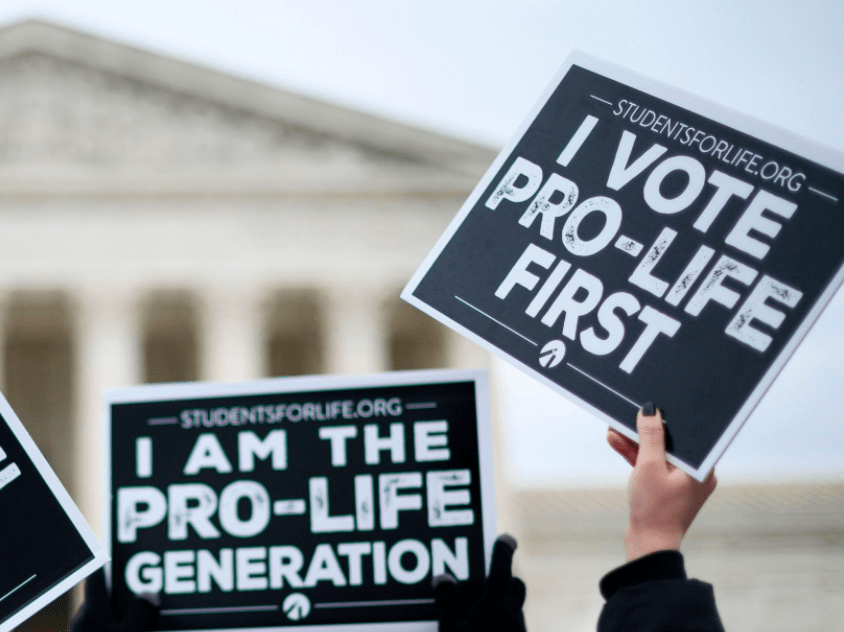
Conservatives who oppose Donald Trump—or, horror of horrors, plan to vote for Joe Biden—are guaranteed to have some version of this accusation hurled at them from fellow pro-lifers. I’ve heard it plenty, especially since I explained publicly why I’ll be voting for Joe Biden. The retired leader of the denomination I belonged to for most of my life recently posted on Facebook, “The Christian has no choice…we must vote for…the Republican Party.” He went on to warn any Christian thinking of voting for a Democrat, “God will hold you accountable for killing human life.” Megachurch Pastor John MacArthur said last month that he personally discussed with President Trump why Christians “could not vote Democratic.” MacArthur went even further, claiming that “any real, true believer” will be voting for Trump. Just before I sat down to write this article, I saw someone on Facebook tell my cousin, “…if you vote for those who will murder babies in or out of the womb, their blood is on your hands.”
No pressure, Christians.
Abortion, more than any other issue, binds conservative Christians to the Republican party. Elected Democrats bear much of the blame for this; their extremist opposition to any form of abortion restriction is wildly out of touch with Americans, a large majority of whom believe abortion ought to be subject to restrictions starting in the second trimester.
To be sure, for anyone like me who believes life begins at conception (not a belief so much as a biological fact), the very idea of abortion is morally repugnant. The argument that a woman ought to be able to choose what to do with “her own body” doesn’t fly with people who understand that one human being can’t have two sets of DNA, four arms, two hearts, two brains. I have personally felt two babies growing inside me, and I assure you they were separate, distinct individuals. I wasn’t kicking my own uterus from the inside—don’t be stupid. The most militant pro-choice people in the world still attend baby showers, not fetus showers, and if they experience the grief of miscarriage, they know that something valuable, irreplaceable, and undeniably human has been lost. “Don’t like abortion? Don’t have one,” sounds the same to me as, “Don’t like slavery? Don’t own one.”
And so, in every election of my life (with the exception of president in 2016), I dutifully voted for the candidates with an R after their names. They were the ones who were pro-life, like me. They were the ones who would fight to protect innocent, vulnerable, unborn babies. They said so. It’s in their party platform.
Everyone in Christian subculture knows the term “nominal Christian.” There are loads of them in America: people who call themselves Christians, who say they believe in God, who show up to church on Christmas and Easter, but whose hearts, lives, and actions remain untouched and unchanged by the gospel. They are Christians in name only.
The Republican Party is nominally pro-life. It’s pro-life in name only.
It’s so searingly obvious to me now that I can’t believe it took me so long to see it. Let me show you, my fellow pro-life conservatives.
Roe v. Wade is the super-villain of the pro-life story, the Big Bad that started it all. (For the record, I believe Roe was a terrible decision, a prime example of “legislating from the bench,” and a lot of legal scholars agree—even Ruth Bader Ginsburg thought it was faulty. I think it ought to be overturned and given to the states to decide, as it should have been in the first place.) Christians are told we must vote for Republican presidents, so they can nominate conservative justices, so we can overturn Roe v. Wade. Overturning Roe v. Wade is the Holy Grail of the pro-life movement.
But on the Supreme Court that delivered Roe v. Wade, six of the nine justices were Republican nominees. Five of those six concurred with the ruling. Legal abortion is the law in America thanks to Republican-appointed justices. Only two justices dissented, and one of them was Democrat-appointed.
For 49 of the past 50 years, the majority of the Supreme Court has been made up of Republican nominees. You read that correctly.
Pro-life Catholic William T. Cavanaugh lays out why if overturning Roe v. Wade were possible, it would have happened by now: “By 1992, pro-life presidents Reagan and George H.W. Bush had appointed five justices, giving the Republicans an 8-to-1 advantage, and the lone Democratic appointee, Byron White, was one of two justices who voted against the Roe decision. If ever Roe v. Wade was going to be overturned, this was the time. But when Planned Parenthood v. Casey came before the court that year, it not only failed to overturn Roe v. Wade, but also outlawed restrictions that put an ‘undue burden’ on women seeking abortions.”
Republicans have held unified control of both houses of Congress and the Presidency for six out of the past twenty years, including the first two years of Donald Trump’s term. Yet Planned Parenthood is still fully funded—they actually received a record-high total of taxpayer dollars during Trump’s presidency after the passage of his new tax bill. No federal personhood bill has even been attempted during any of the six years Republicans held complete power.
In late February 2019, during debate over the “Born-Alive Abortion Survivors Protection Bill”, Senate Republicans seized the opportunity to cast Democrats as inhuman monsters who want dying babies left alone and unaided as they gasp for air. Democrats called the bill a “political stunt” and pointed out that it is already a crime to not provide care to infants born alive after an attempted abortion. In the end, the Republican-held Senate didn’t have a filibuster-proof majority, so the bill failed to receive a vote—as predicted.
Less than five weeks later, those same Senate Republicans used the “nuclear option” to kill the filibuster, in order to speed up confirmation of President Trump’s judicial and executive branch nominees.
So I have to ask my fellow pro-lifers: Why was filling government positions more important to the Republicans they elected than protecting the lives of babies? Why did Republicans fight harder and dirtier to confirm judges than to prevent infanticide? They had the power to overrule the Democrats during the Born-Alive fight if they really wanted to—they proved it just weeks later. But they chose not to use that power in the fight for life. Why?
During the recent Vice-Presidential debate, Mike Pence was asked directly about that pro-life dream-come-true: a world where Roe v. Wade has been overturned. “If Roe v Wade is overturned, what would you want Indiana to do? Would you want your home state to ban all abortions?” What an opportunity for the pro-life VP to make a passionate, eloquent statement about the value of all human life! To argue convincingly before millions of Americans why we ought to turn our backs on the barbarity of abortion!
Because the Republican Party is only nominally pro-life.
I’m not talking about Republican voters; I know firsthand that so many of them fervently believe in protecting unborn babies—indeed, it is the one thread that has kept some of them connected to a president they would otherwise disapprove of. I’m talking about Republican politicians, who are keenly aware of this dynamic.
When the GOP knows that abortion will keep evangelicals voting for them en masse year after year, why wouldn’t they keep using it to court us? When wielding abortion as a club has been so effective at beating otherwise dissatisfied Christian voters into submission, why would they want to surrender it? When their leader, the most immoral, offensive, un-Christlike man imaginable, can do and say as many indefensible things as he wants because a huge portion of their base will always say, “But abortion!” and vote for them anyway, why would they ever voluntarily lose that advantage?
In his recent book, Pastor Patrick Kahnke bottom lines it for us: “Most Republican politicians have no real interest in seeing meaningful progress on the abortion issue, because once that happens, they will lose the hold they have on their evangelical base.”
My entire life, I’ve been told I must vote Republican to save babies’ lives. But for almost 50 years, electing Republicans has not ended abortion. They’ve done precious little to even curb it. They did pass a partial-birth abortion ban in 2003; I’ll give them that. But abortion providers simply get around this law by killing the baby in the womb before it is delivered. The ban has made no real impact. The overall rate of abortions has dropped steadily since Roe—but it has dropped slightly faster under Democrat presidents.
At the state level, yes, Republicans have made real attempts to restrict abortion (most of which have so far been struck down by the majority Republican-nominated Supreme Court.) But at the federal level, their track record is clear. The GOP doesn’t really want to end abortion.
Some of you may wonder if I’m being too cynical. Is the party well-meaning but just inept and unable to enact its agenda when in power? No, clearly not. Republicans have seen great success at cutting taxes, rolling back environmental protections, defending gun rights, lavishly funding the military, and keeping health care largely run by the private sector. They know how to get wins when they’re in the majority.
And they know how to keep their base in line. Casting themselves as righteous crusaders for life against the forces of evil is a very powerful weapon. Powerful enough to keep “pro-life” people voting for them while they mock Americans for trying to protect their fellow citizens’ lives by wearing masks. While saying older people should be willing to die to keep the economy running smoothly. While slashing the number of refugees we welcome by over 80%—to hell with your tired, your poor, your huddled masses yearning to breathe free. While responding with shrugs when a whistleblower nurse reported forced hysterectomies on immigrant women at ICE facilities—it’s probably best if those women don’t have babies, anyway. While saying COVID-19 “affects virtually nobody” as 200,000 Americans lay dead from the virus. While refusing to even answer whether they’ve ever impregnated a woman who then had an abortion.
The Republican Party is pro-life in name only.
My pro-life friends, I don’t expect you all to vote for a Democrat. I understand why some of you can’t bring yourselves to do it—though perhaps you’ll be encouraged, as I was, to learn of the group, Democrats For Life of America, who recently took out a full page ad in the New York Times urging their party to moderate on the issue of abortion.
But I hope you can see now that being single-issue voters has gotten us nothing. For half a century, it has gotten us nothing. Worse than nothing: we have handcuffed ourselves to a party that is cynically using us. I will not be lectured any longer by fellow pro-lifers who tell me I must vote Republican. The blinders are off.
I’m pro-life, and I’m voting for Joe Biden even though he’s wrong about abortion, because the GOP needs chemo. In the meantime, as we have done for years, my family will continue donating to pro-life organizations that help women choose life by providing real, practical support for them and their babies.
It’s clearly a better use of our efforts than voting for Republicans.
After fighting tooth and nail for years to keep his tax returns secret, Donald Trump has been thwarted. Not by one of several court orders that he turn them over, but by an unnamed source who gave them to the New York Times.
(Anticipating angry reactions, I will say here that based on my very brief research, whoever leaked the tax returns probably broke federal law. However, the Times is very likely safe in publishing them on First Amendment grounds.)
Trump paid $750 in federal income taxes the year he won the presidency. In his first year in the White House, he paid another $750.
He paid no income taxes at all in 10 of the previous 15 years.
He is in a years-long fight with the IRS over a $72.9 million tax refund he claimed and received. If he loses, he’ll owe $100 million or more.
The majority of his main businesses report losing millions, and in some cases tens of millions, every year.
Over the next four years, he is personally responsible for more than $300 million in loans coming due.
There is far more information in the article, of course, including the revelations that he wrote off as business expenses $70,000 worth of hairstyling during his time on The Apprentice, as well as the fees paid to the defense attorney who represented him during the Russia investigation.
The report has touched off a firestorm of speculation and political calculations. The president has called it fake news. (If the leaked returns are fake, he could easily set the record straight by releasing his actual tax returns.) There are massive amounts of information stemming from this reporting, and hundreds of rabbit trails to follow. I want to present you with some of the perspectives and possibilities I find most compelling and important to consider:
First, the president’s attorney points out that he did pay some income taxes in the 15 years preceding the election; that’s why he was able to claim a $72.9 million tax refund. (The second half of that sentence seems to me to cancel out the first, but I wanted to note it.)
Many of the president’s defenders are pointing out that virtually everyone takes advantage of every method possible for reducing tax liability, and Trump is no different; in fact, he is just better at it than everyone else. I suppose this is possible. If true, and legal, we need major tax reform, because there is no universe where it is fair for an actual billionaire to pay less in taxes than my family, and approximately half the families in the US. But I think three other scenarios are far more likely: 1. He is a terrible, terrible businessman. 2. He has committed tax fraud. 3. He is a terrible, terrible businessman who has committed tax fraud.
Many of Trump’s detractors are claiming these returns prove he is broke, and not really a billionaire after all. Forbes disagrees, saying he is still a billionaire, albeit one who is carrying over $1 billion in total debt, and that this makes his $750 tax payments even more scandalous.
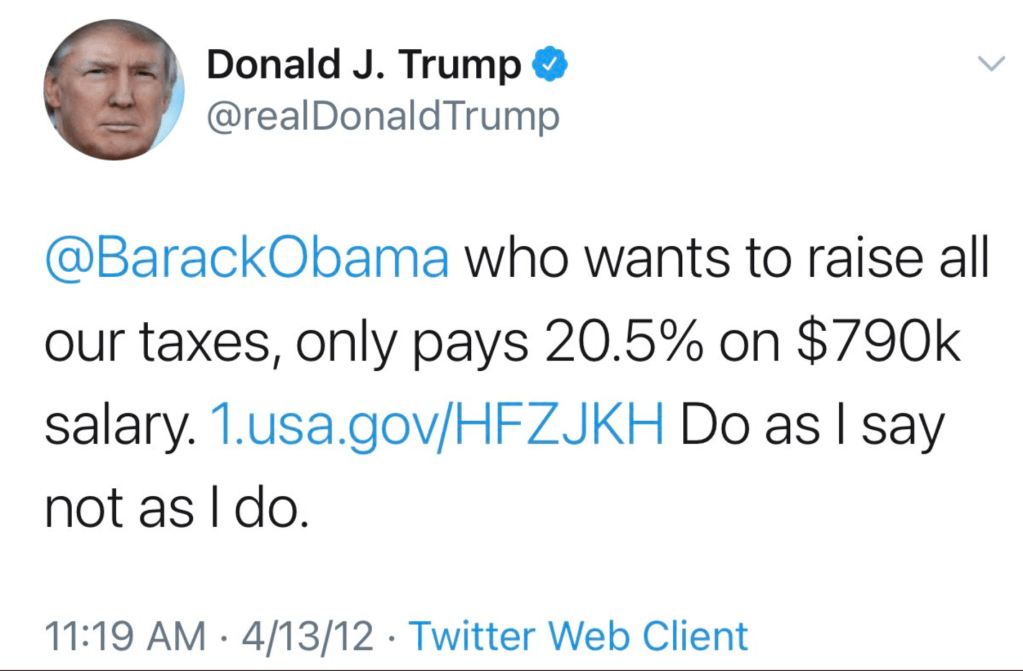
Two Trump truisms in one here: His criticisms are always projection, and there is always a tweet.
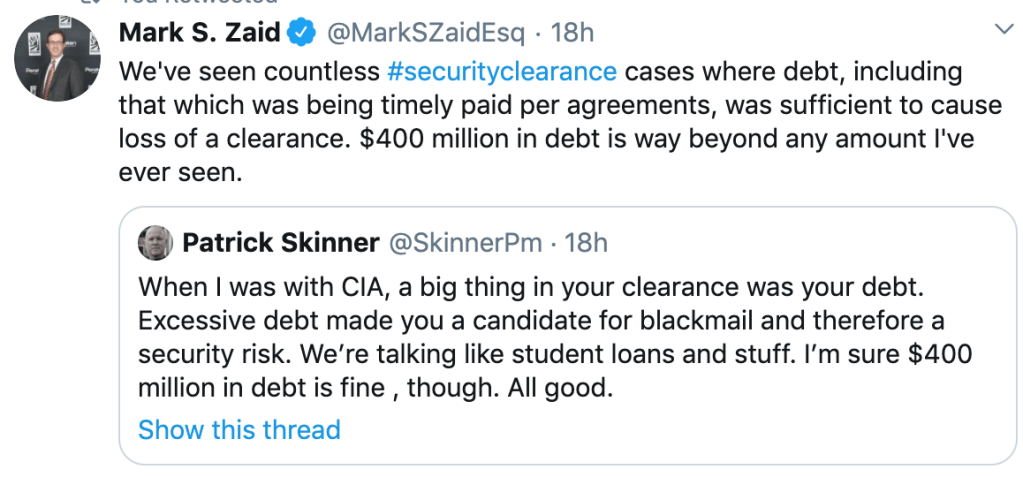
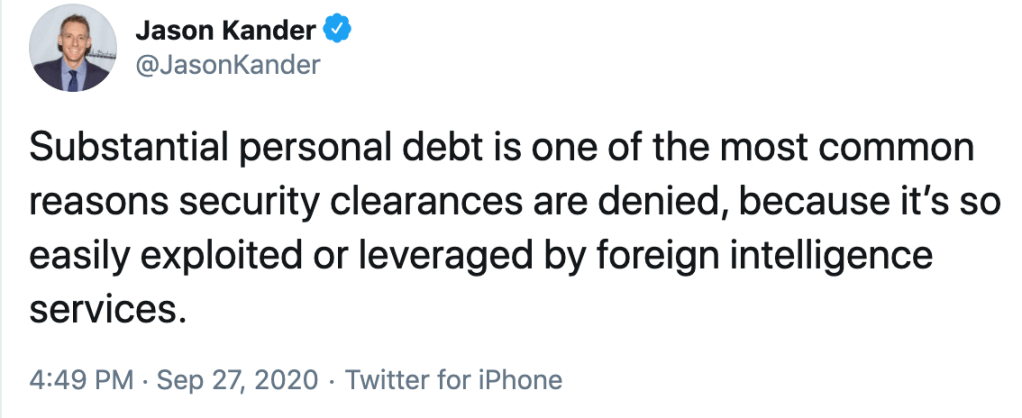
There’s a lot more to this story than just the taxes, though. People who know a lot about security clearances are alarmed at the high level of debt carried personally by the president. Mark Zaid, a verified account on Twitter, is an attorney specializing in national security, security clearances, and government investigations. He had this to say:
Jason Kander, attorney and former Secretary of State for Missouri, said this:
I’m not aware of any evidence that the president is being blackmailed or having his debts exploited by foreign interests, but it’s obviously a concern whenever anyone is being considered for any level of security clearance—let alone the very highest. When the person with that highest clearance has fought for years to keep those debts hidden, concern turns to red flags and alarm bells.
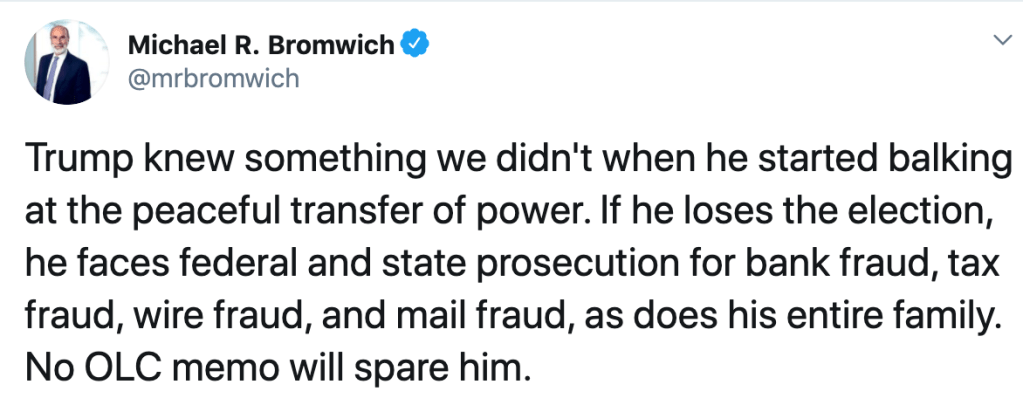
The most extreme reactions have been those claiming that Trump has committed crimes in his tax and business dealings. I’m taking these allegations with a big grain of salt, but Michael Bromwich joining in really caught my attention. He is a former Inspector General of the Department of Justice, as well as former prosecutor for the Southern District of New York, which I’ve written about before. Of all the people who could comment on this topic, he is certainly one of the most knowledgeable. And he did not mince words:
He is referencing the Justice Department’s Office of Legal Counsel memo, which set the standard that a sitting president cannot be indicted. He’s agreeing with those who believe Trump may refuse to leave office even if he loses the election, because it’s the only way to protect himself from facing charges. Others have wondered whether he may resign if he loses, making Pence president temporarily—long enough to pardon Trump for any crimes. This is, of course, all speculation. I only mention it because I believe someone of Bromwich’s stature gives this conjecture a lot more weight than your standard rumor.
It remains to be seen whether these revelations will affect the election. A lot of people who voted for him may be surprised to learn that the brilliant businessman they hired because he puts America first actually paid far more in taxes in 2017 to Panama, India, and the Philippines than he did to the US, and that most of his business ventures are hemorrhaging cash. It probably won’t. The vast majority of voters have already made up their minds. What is less certain is what will happen after the election, especially if Trump loses. Plenty of rich celebrities have been convicted of tax evasion, and even done prison time, but to my knowledge, no former presidents.
Regardless of what happens, I just keep thinking about all the things my family could have done this year if we’d only had to pay $750 in income tax.
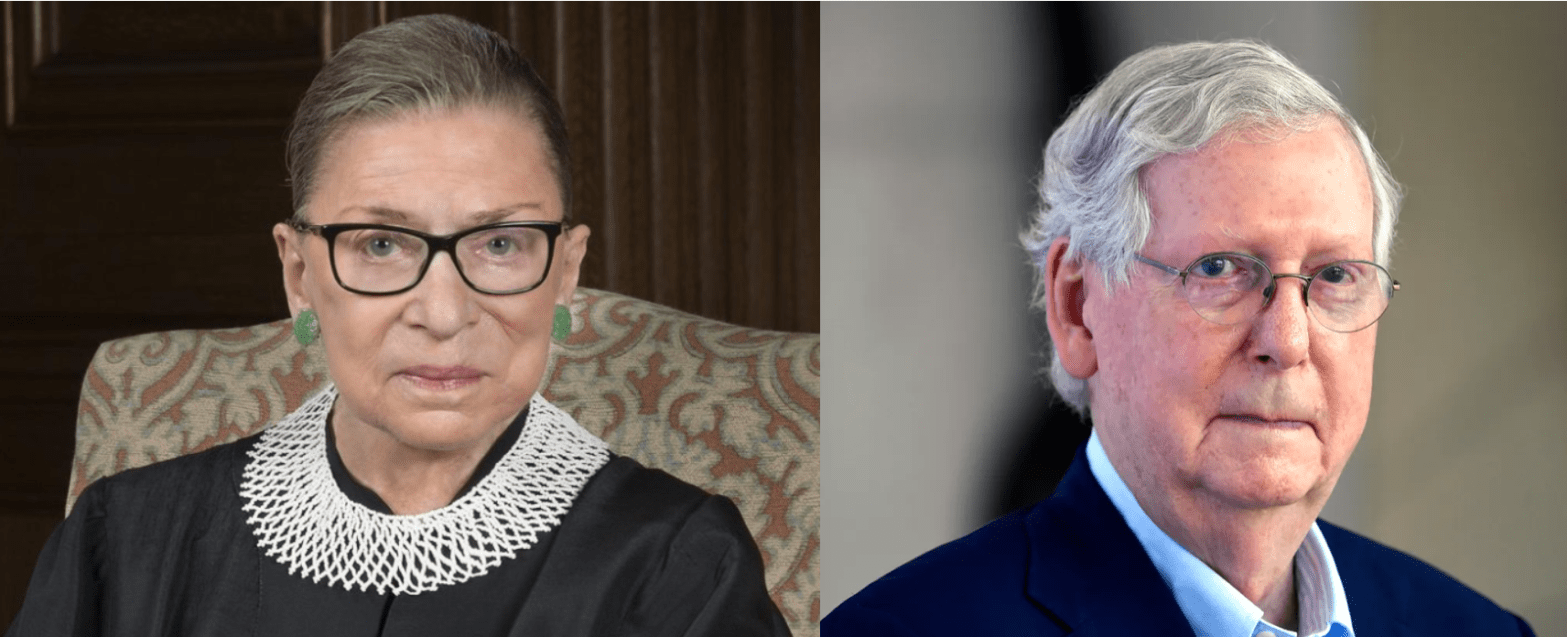
The pre-election event I most feared has happened. Justice Ruth Bader Ginsburg has died.
Her now-empty seat on the Supreme Court has the potential to polarize our deeply divided nation even further. The last Supreme Court confirmation hearings were so poisonous I nearly quit Facebook. I saw Christine Blasey-Ford called a “lying skank,” and Brett Kavanaugh called a rapist and a “rich white man throwing a fit because for the first time in his life, he might not get what he wants,” by people who’d never met them and knew absolutely nothing about them except which political team they were batting for. I watched Senators whose job was to discover the truth instead using their time to showboat and create soundbites for their bases.
How did something as fundamental to our system of government as seating Supreme Court justices become so contentious? Why are Republicans like Lindsey Graham willing to do a complete 180 on filling this seat when he explicitly said he wouldn’t, and we have all the receipts?
“I want you to use my words against me. If there’s a Republican president in 2016 and a vacancy occurs in the last year of the first term, you can say Lindsey Graham said let’s let the next president, whoever it might be, make that nomination." pic.twitter.com/quD1K5j9pz
“That’s gonna be the new rule,” he said, after spelling out the exact situation we now find ourselves in. Yet he has already announced that he will do the opposite of what he promised, and support any nominee President Trump puts forward now. Why would a Senator who is up for reelection take such a huge risk: being seen by voters as a shameless opportunist and proven liar?
It wasn’t always like this.
Justice Antonin Scalia, a consummate originalist and hero to conservatives, was nominated by Reagan and confirmed by the Senate in 1986 by a 98-0 vote. Seven years later, Ruth Bader Ginsburg, who would become the leader of the liberal wing of the Court, was confirmed by a 96-3 vote. (If you are unfamiliar with the beautiful friendship between these two ideologically opposed justices, you should read this.)
So what has changed? There are entire books written about this topic, but let’s just hit the highlights:
Robert Bork: In 1987, just a year after Scalia was seated, Reagan nominated Robert Bork to the Court. Senator Ted Kennedy attacked the nominee with blistering accusations based on some of Bork’s previous rulings, public statements, and his role in the Watergate scandal: “In Robert Bork’s America, there is no room at the inn for blacks and no place in the Constitution for women, and in our America there should be no seat on the Supreme Court for Robert Bork.” Bork’s fate was sealed, and his confirmation failed in a 42-58 vote, mostly along party lines. Democrats saw this as a righteous victory, keeping a dangerous and backwards ideology out of the Supreme Court. But to Republicans, it was a vicious political hit job whose unfairness was so unprecedented that it became a new word:
Clarence Thomas: Four years later, Democrats again hotly contested a Republican president’s nominee: Clarence Thomas. A former Thomas employee, Anita Hill, came forward with lurid allegations of sexual harassment, which Thomas categorically denied. Predictably, the Democrats generally believed Hill while the Republicans sided with Thomas. However, Democrats chose not to filibuster; Thomas received an up-down vote, and was confirmed to the Court—just barely: 52-48.
Miguel Estrada: In 2001, George W Bush nominated Miguel Estrada to the DC Circuit Court of Appeals, the court considered by many to be the second most important court in the country; more Supreme Court justices have come from there than any other court. Estrada had the support of a majority of the Senate, but Democrats took the extraordinary step of filibustering his appointment, at the request of liberal interest groupswho called Estrada “especially dangerous” because “he is Latino, and the White House seems to be grooming him for a Supreme Court appointment.” In other words, Democrats didn’t want Republicans to put the first Hispanic—a conservative—on the Supreme Court. Democrats claimed Estrada failed to adequately answer their questions.
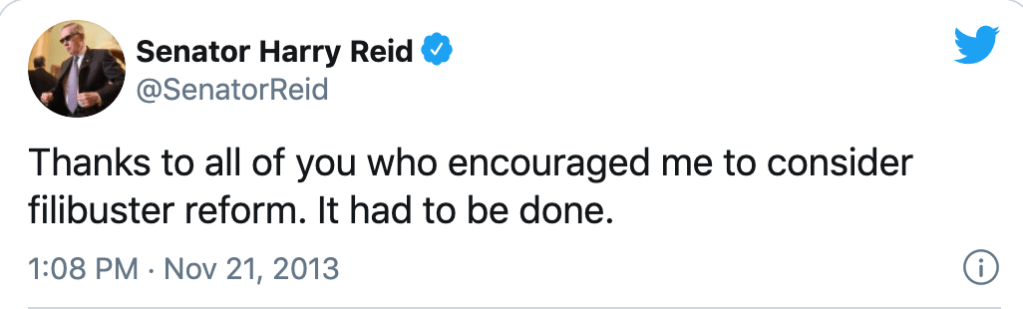
Using, then killing, the filibuster: Senate Democrats went on to filibuster a total of ten Bush circuit court nominees, all of whom would have been confirmed if they’d been given a vote in the Senate. In the Washington Post, Marc Thiessen writes, “After Democrats won control of the Senate and the White House, they set about trying to fill court vacancies — particularly on the D.C. Circuit — with judges so left-wing they knew they could not meet the 60-vote ‘standard.’ When Republicans (following the precedent Democrats had set) filibustered some of President Barack Obama’s nominees, Democrats again broke precedent and eliminated the filibuster for all but Supreme Court nominees.” This is known as the “nuclear option.” Normally, it takes 60 votes to end debate in the Senate and move to a vote. But with the nuclear option, the majority party can suspend the normal rules and kill the filibuster with a simple majority vote. Majority Leader Harry Reid (D) was unrepentant.
To put it simply, Democrats set a new, more vicious precedent. When Republicans followed that precedent, Democrats went even further, using the nuclear option (what Reid euphemistically called “filibuster reform”) to force through more judges.
His smug victory would be short-lived.
Merrick Garland: In 2016, Barack Obama’s final year in office, he nominated Merrick Garland to replace the deceased Justice Scalia. Senate Majority Leader Mitch McConnell (R) refused to even hold hearings for Garland, saying his decision was “about a principle, not a person.” He claimed that with an election coming up so soon (8 months), “The American people are perfectly capable of having their say on this issue, so let’s give them a voice. Let’s let the American people decide.”
McConnell’s fellow Republican Senators agreed. Chuck Grassley said, “The American people shouldn’t be denied a voice.” John Cornyn said, “The only way to empower the American people and ensure they have a voice is for the next President to make the nomination to fill this vacancy.” James Inhofe said, “I will oppose this nomination as I firmly believe we must let the people decide the Supreme Court’s future.” Many others all said the same basic thing.
True to their word, Senate Republicans held the seat empty for a record 422 days: the longest vacancy since Congress settled on a 9-seat Supreme Court in 1869.
Neil Gorsuch: Donald Trump’s nominee to fill Scalia’s seat faced a Democratic filibuster. Republicans responded by taking Harry Reid’s “filibuster reform” one step further, extending it to Supreme Court confirmations. They used the nuclear option to change Senate rules, and confirmed Gorsuch 54-45. As Thiessen explains, “Had Democrats not tried to block Gorsuch, they would still have the filibuster. And Republicans, who now have just a single-vote majority, would have a much more difficult time mustering the votes to change Senate rules today. But thanks to Democrats’ miscalculations, the GOP doesn’t have to.”
Brett Kavanaugh: I don’t have the stomach to do a deep dive into this ugly debacle. Personally, I found Christine Blasey-Ford a compelling and sympathetic witness whose story suffered from numerous inconsistencies, and later was mortally wounded by her own attorney, who admitted her political motivations at a feminist conference: “When he takes a scalpel to Roe v. Wade, we will know who he is, we know his character, and we know what motivates him…it is important that we know, and that is part of what motivated Christine.” I thought Brett Kavanaugh hurt his credibility with his combative testimony, but that ultimately the charges against him were never satisfactorily proven.
But it doesn’t matter what I think. I watched in horror as seemingly every other person in America became 100% convinced they knew the absolute truth of what did or didn’t happen that night so many years ago, and ruthlessly judged half the country based on that certainty. The Kavanaugh hearings illustrated like nothing before how hopelessly divided by tribalism we’d become.
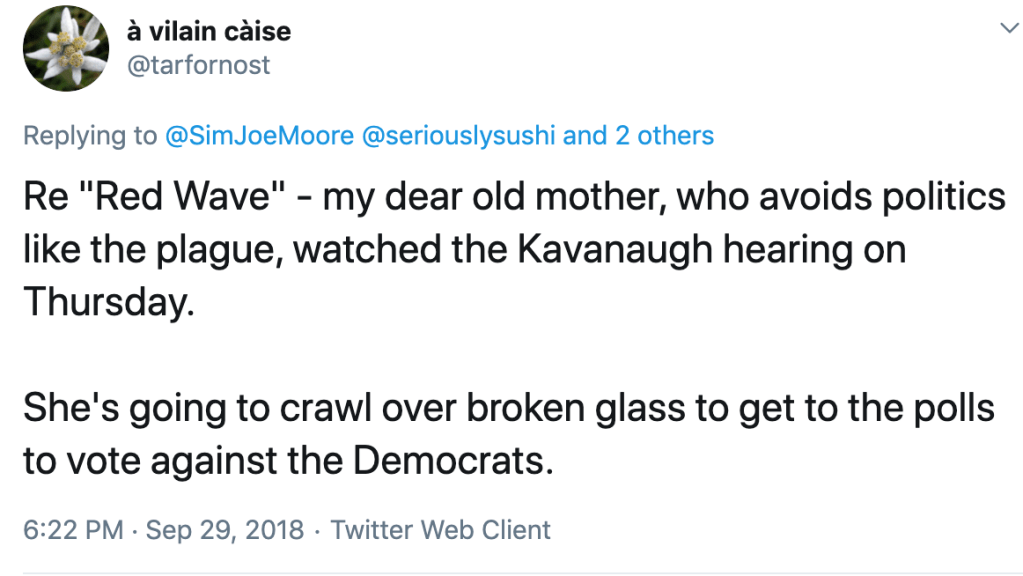
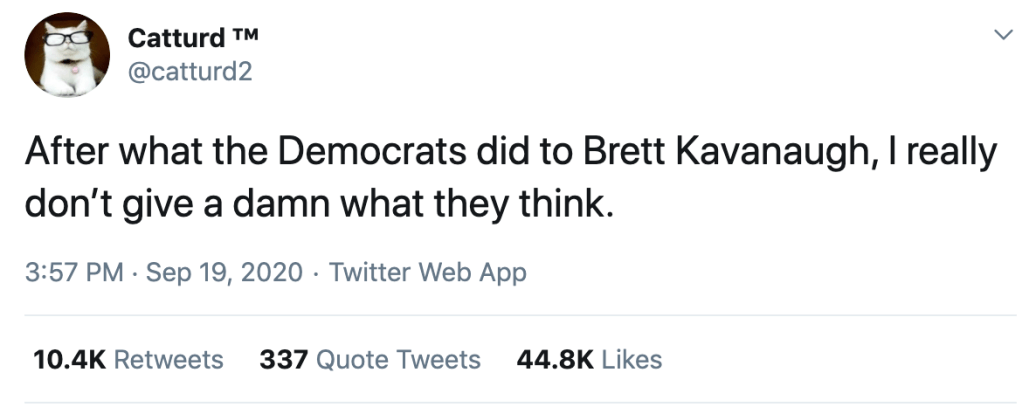
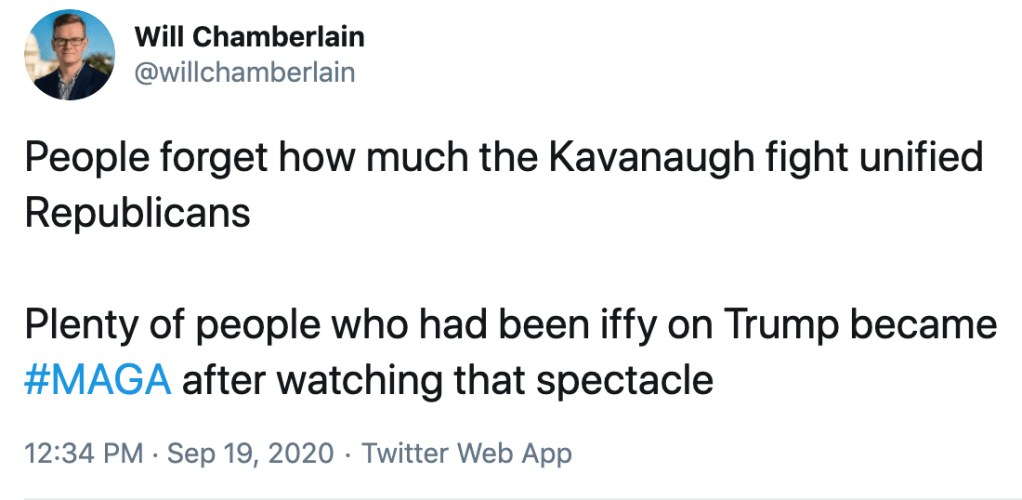
I have only anecdotal evidence, but the Kavanaugh hearings seemed to galvanize Republicans who’d been on the fence about Trump.
The minority Democrats, without the filibuster, were powerless to stop a vote on Kavanaugh. He was confirmed 50-48.
Which brings us to today. Now, with six weeks left before the election, the Republican White House and Senate find themselves with an empty seat on the Supreme Court. Four years after insisting that the American people should make the choice in this situation via the election—indeed, after giving their word that they would not fill a seat in this exact situation—they are poised to prove that they never meant a word of it.
The truth is they denied Merrick Garland a vote because they didn’t want him on the Court, and they had the power to stop him. They’ll fill RBG’s seat despite their promises because they want to, and they have the power.
They learned all about using your power to get what you want, precedent be damned, from the Democrats. Some of whom, by the way, are already threatening to “pack the Court” once they retake the White House and Senate. They can just change the rules yet again, adding more seats to the Court and filling them with left-leaning justices. It’s a plan RBG condemned: “If anything would make the court look partisan,” she said, “it would be that — one side saying, ‘When we’re in power, we’re going to enlarge the number of judges, so we would have more people who would vote the way we want them to.'”
But Democrats are rightly enraged by Republicans’ reneging on their promises and lighting their supposed principles on fire the instant it’s in their interest—which Republicans say they’re doing because Democrats would do the same.
And so it’s a race to the bottom, with each side becoming ever more brazenly committed to gaining and keeping power at any cost.
Something has to give. Someone has to choose to compromise, to find some common ground, or this will not end well for America.
So far, I haven’t blamed the president for COVID deaths. Blaming elected leaders for citizens’ deaths is a low blow, and almost always hyperbole. Yes, I’ve said he’s mismanaged our response to the pandemic; I’ve said he wasted precious time; he’s obviously undermined his own experts repeatedly. But I thought his behavior was born of stubbornness and wishful thinking, not active malevolence.
I was being far too generous.
President Trump gave Bob Woodward—one half of the journalistic team that brought down Nixon—eighteen interviews, which Woodward recorded. He also encouraged White House officials to talk to Woodward, believing his upcoming book would be sympathetic to Trump. (I said he was malevolent; I didn’t say he was smart.) On February 7—February 7—he revealed the following:
“It goes through the air, Bob…you just breathe the air and that’s how it’s passed…It’s also more deadly than your—you know, your, even your strenuous flus. You know, people don’t realize, we lose 25,000, 30,000 people a year here. Who would ever think that, right? Pretty amazing. And then I say, well, is that the same thing? This is more deadly. This is 5 per—you know, this is 5 percent versus 1 percent and less than 1 percent. You know? So, this is deadly stuff.”
In the same interview, he said it could also kill young people as well as the elderly.
To recap, by February 7, Trump knew that coronavirus was passed through the air and therefore highly contagious, could kill anyone, and was at least five times deadlier than the flu. He knew.
Armed with this information, the president then did the following:
Feb 27: At a press conference, Trump says of COVID, “View this the same as the flu…Treat this like you treat the flu, and it’s gonna be fine.”
Feb 28: Rally in South Carolina, thousands attend. “Democrats are politicizing the coronavirus,” Trump tells them. “They tried the impeachment hoax,” he says, then lumps the virus in with Russia and impeachment: “And this is their new hoax.”
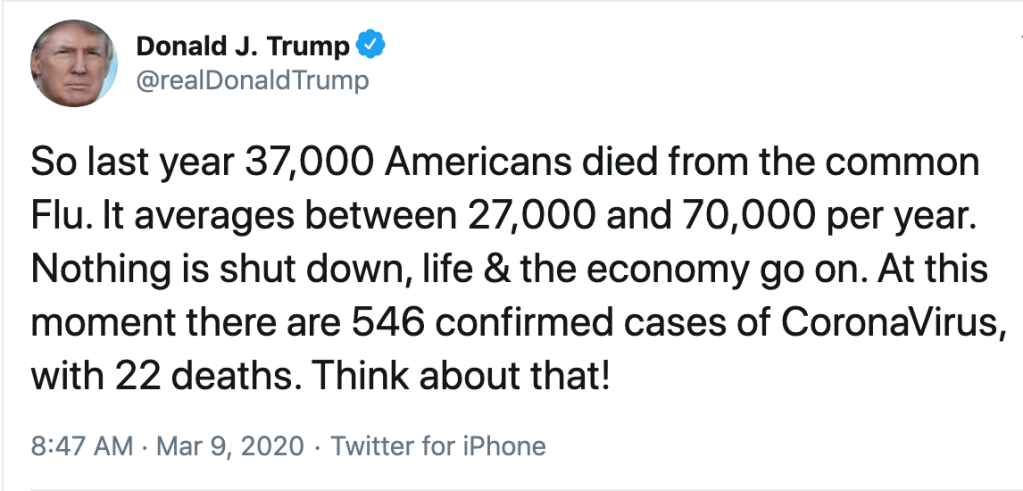
Mar 9: More than a month after telling Woodward the virus was at least five times deadlier than the flu, he tweeted this:
That was 190,978 deaths ago.
But people listen to him. They believe him. They believe in him. He is the President of the United States of America. I have personally heard directly from multiple Trump supporters that the virus is a hoax, that it’s a tool of Democrats and media to affect the election, that it’s no worse than the flu. Millions of Americans believe these things he told them. He has inarguably influenced people’s perception of risk, and therefore their behavior—which has almost certainly led to thousands upon thousands of deaths.
Over and over and over, the president downplayed the risk this virus posed to Americans. In other words, he deliberately lied to us. His supporters can’t simply deny it: he said it directly to Bob Woodward, on tape, on March 19. “I wanted to always play it down. I still like playing it down, because I don’t want to create a panic.”
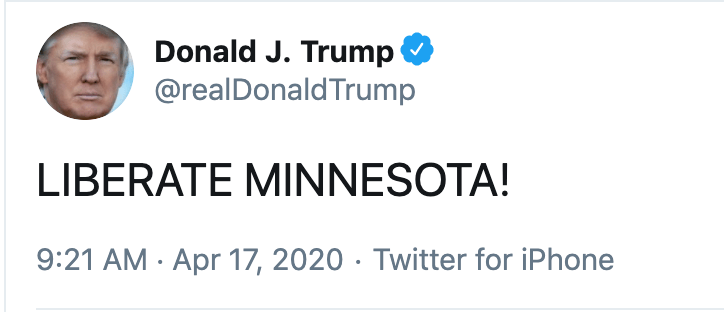
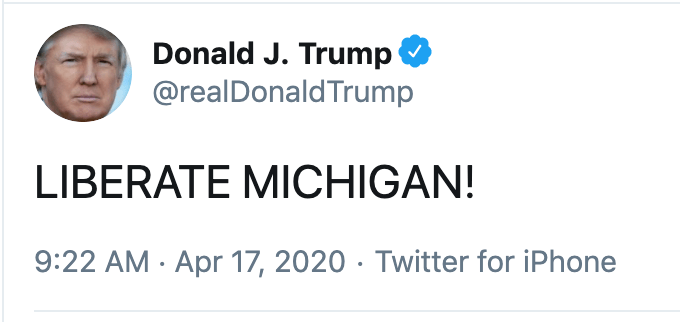
That’s the line he and the GOP are sticking with—it’s his only conceivable defense. In fact, just yesterday he told Sean Hannity, “I don’t want to scare people.” So let’s take a closer look at how consistent he’s been in choosing not to scare Americans.
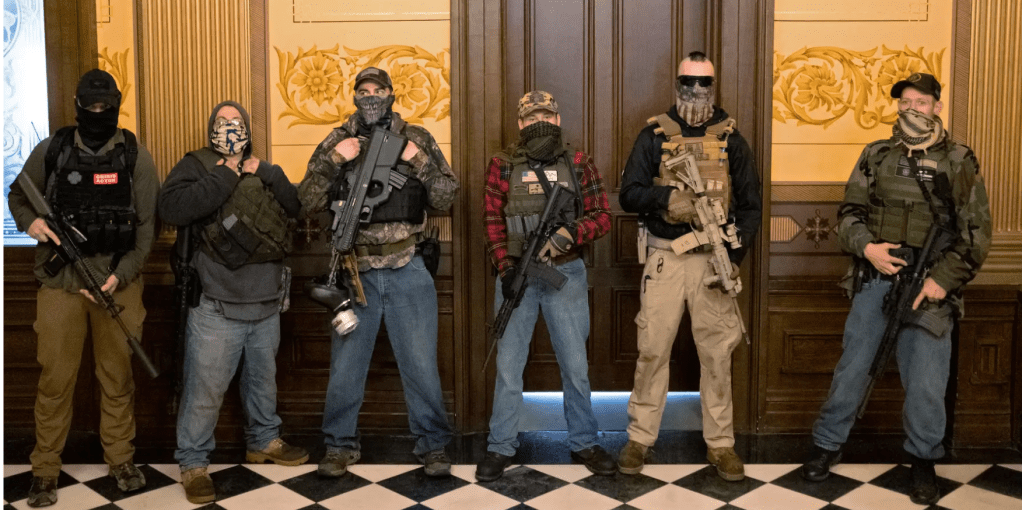
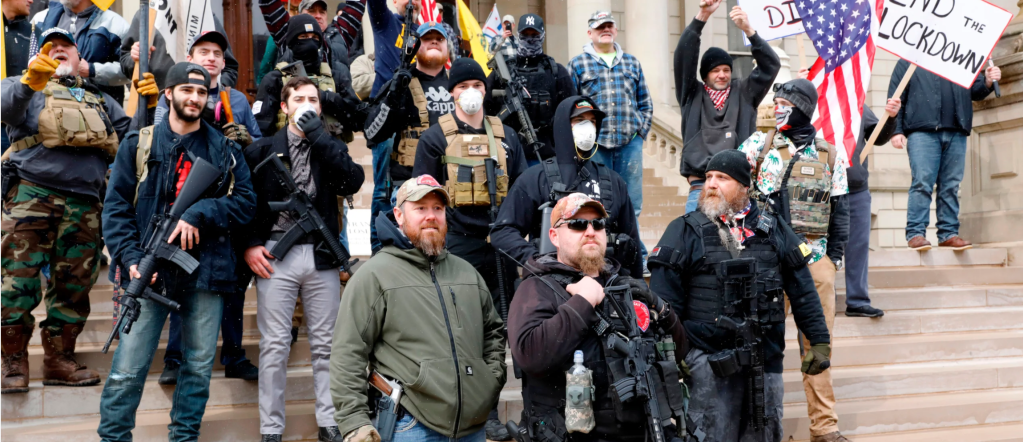
Very calming. Definitely wouldn’t lead to scenes like this in the Michigan legislature shortly after:
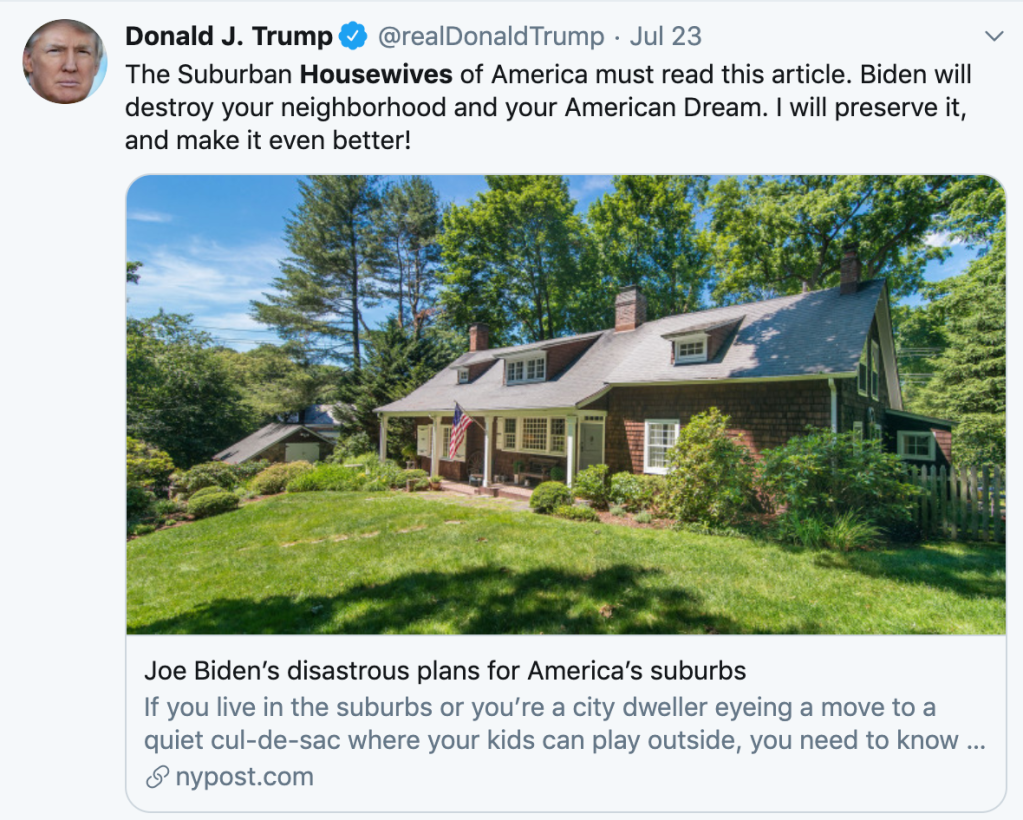
He doesn’t want to scare anyone, but you should know that Joe Biden is going to destroy your neighborhood and the American Dream.
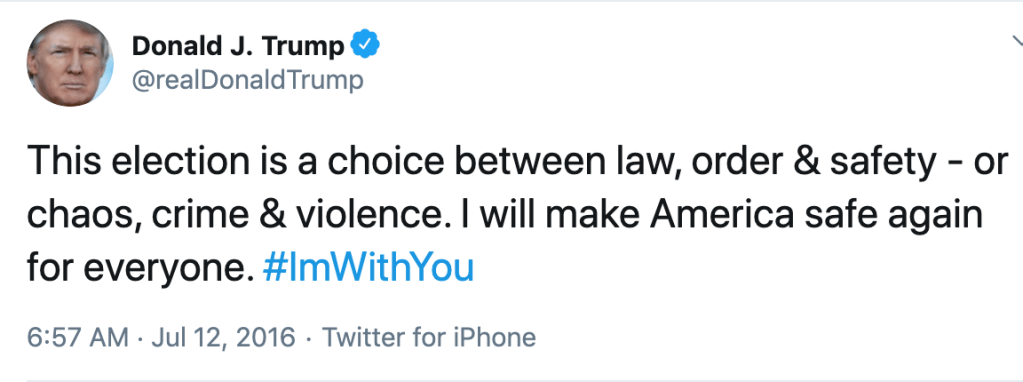
Even back in 2016, he didn’t want to scare me, but did want to let me know that if I didn’t vote for him, I would get chaos, crime, and violence.
He turned out to be right about that one.
He doesn’t want to scare anyone, but this past Friday in New Hampshire he warned voters, “Just look at Joe Biden supporters on the street screaming and shouting at bystanders with unhinged, manic rage.”
In 2018, he wasn’t trying to scare Americans when he tweeted that “Many Gang Members and some very bad people are mixed into the Caravan heading to our Southern Border,” a caravan he characterized as “an invasion.”
Yes, President Trump does not want to scare anyone—unless it’s politically advantageous for him.
Any competent, ethical leader could have landed somewhere in the middle of the spectrum between “not panicking the populace” and “deliberately lying to Americans for months and giving half the country a drastically inaccurate understanding of the threat we face.”
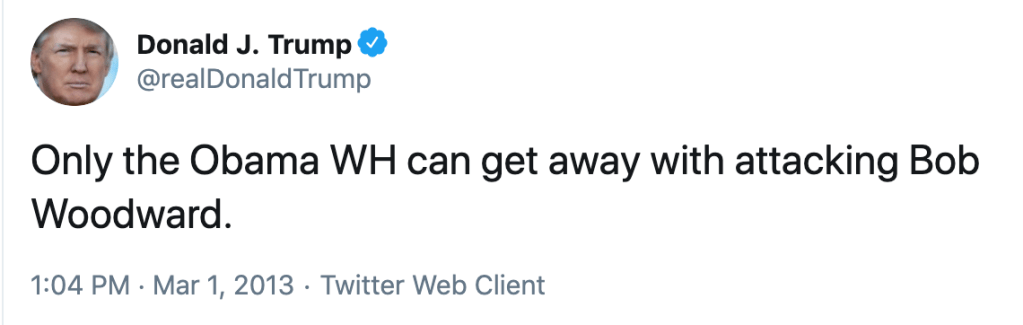
Naturally, Trump has lashed out at the man he gave those eighteen interviews to, accusing him of a “political hit job,” calling his book “boring,” and referring to him as “rapidly fading Bob Woodward.” But the president is forgetting one of the natural laws of Trumpian physics: there is always a tweet.
I don’t know if any of this will move the needle. Trump famously bragged that he could shoot someone on Fifth Avenue and not lose any supporters, and what seemed hyperbolic at the time has proven to be shockingly accurate.
But I keep coming back to those rallies. He knew how contagious it was; he knew how deadly it was, and he still filled those arenas with thousands of people who loved him, so he could hear them cheer and chant his name while he lied to them. He cared more about his own insatiable need for praise than his supporters’ lives.
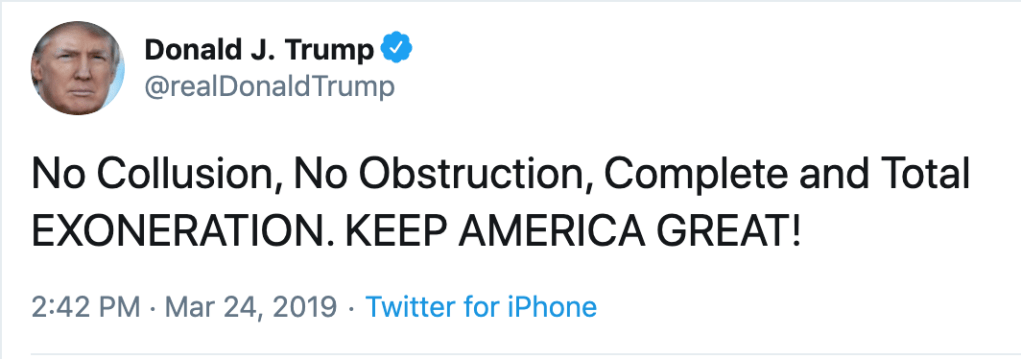
Remember the few years our country spent hearing about the Trump campaign’s ties to, and possible collusion with, Russia? Remember how President Trump insisted the entire time that the whole thing was a hoax? A witch hunt? Remember when the Mueller Report finally came out, and the president claimed it totally exonerated him?
Only for Robert Mueller to respond repeatedly that his report did no such thing?
Have you seen how right-wing pundits, FOX News, and most of the GOP have enthusiastically embraced Trump’s claim that it was all a hoax?
Well. The GOP-led Senate Intelligence Committee recently released its fifth and final report on Russian interference in the 2016 election. And wow.
Before I dive into the report highlights, let’s look at a few other highlights (lowlights?) from Trump’s history with Russia and its presidentdictator-for-life, Vladimir Putin.
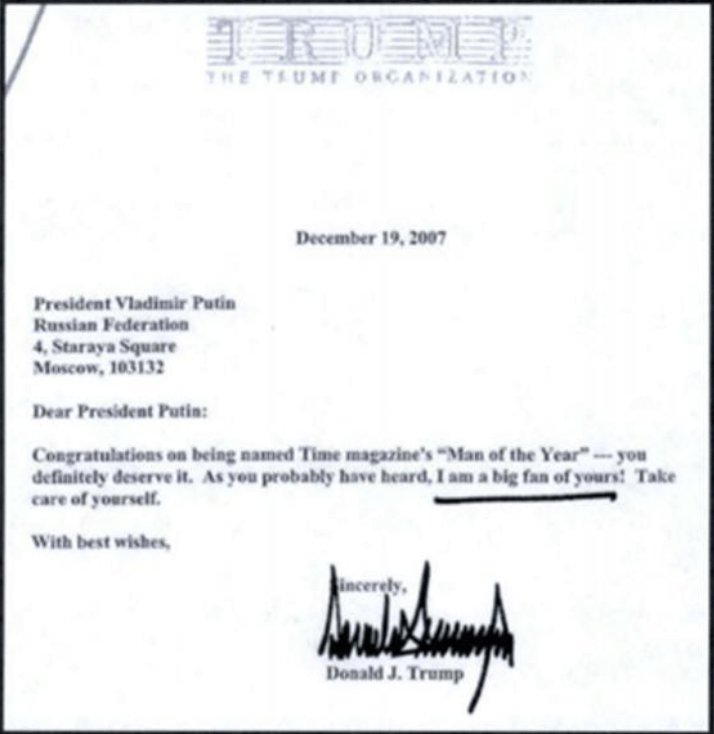
In 2007, private citizen Trump wrote a congratulatory letter to Putin after he was named TIME magazine’s “Person of the Year.” Trump wrote, “…you definitely deserve it,” followed by, “I am a big fan of yours!” underlined in black marker.
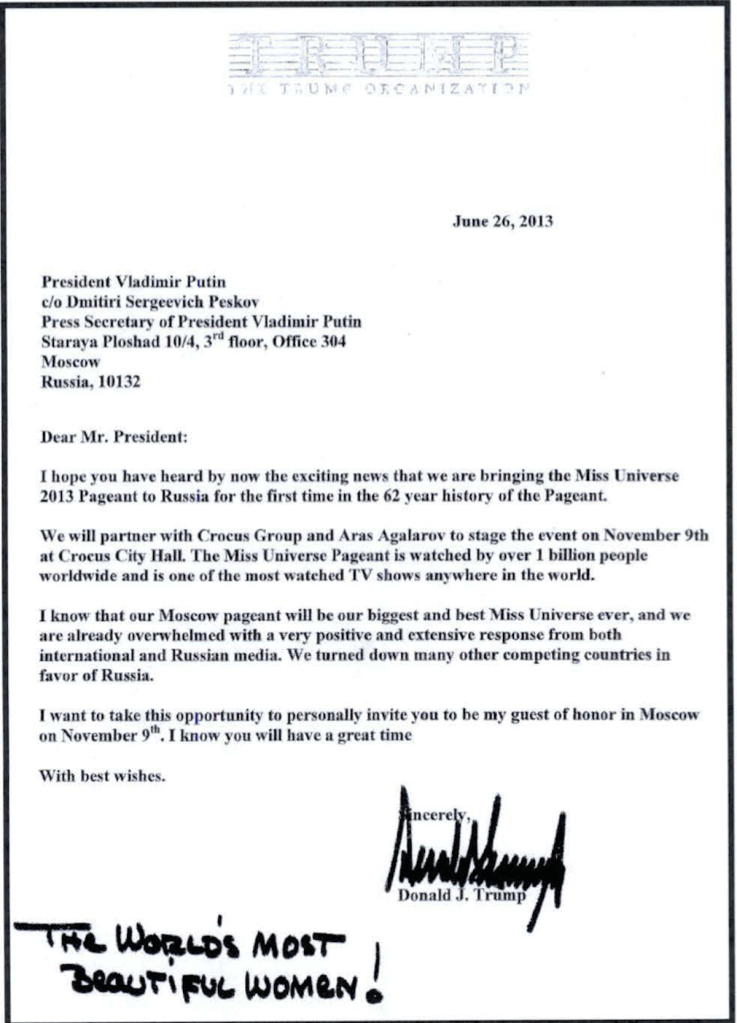
A few years later, in 2013, Trump wondered via tweet whether Vladimir would be attending the Miss Universe Pageant in Moscow, and whether Putin would “become my new best friend?” Eight days later, he sent another letter, inviting Putin to be his “guest of honor” at the pageant. He handwrote a note in black marker at the bottom: “THE WORLD’S MOST BEAUTIFUL WOMEN!”
Fast-forward to a press conference in July, 2016, during the presidential campaign. Trump said he hoped that Russia had hacked Hillary Clinton’s emails while she was Secretary of State. He went on: “I will tell you this: Russia, if you’re listening, I hope you’re able to find the 30,000 emails that are missing.” He later claimed it was a joke, but it turned out Russia was listening. Robert Mueller’s investigation found that the first Russian attempt to hack Clinton’s server happened that same day.
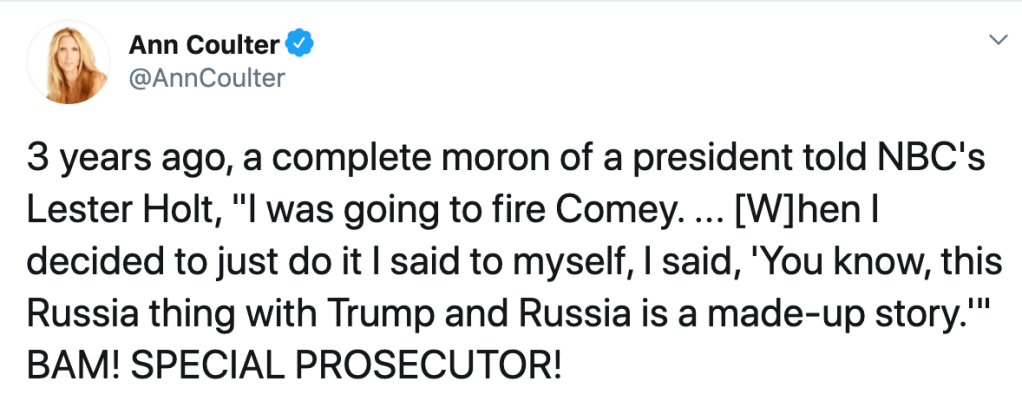
Concern in the intelligence community mounted, fueled partially by the now-infamous Steele Dossier, put together by a former British intelligence agent. The president fired FBI director James Comey, and Congress appointed a special prosecutor to look into the allegations. Trump insisted the whole thing was a witch hunt, and some Republicans claimed the Mueller investigation was illegal. I’ll leave it to Ann Coulter, one of candidate Trump’s earliest and biggest supporters, to contradict them:
Throughout the investigation, Trump indignantly insisted there had been no collusion, and that the Mueller investigation was a hoax. And in July 2018, he stood in Helsinki next to Vladimir Putin and sided with him against the entire American intelligence community. “President Putin says it’s not Russia. I don’t see any reason why it would be,” he said. “I have great confidence in my intelligence people, but I will tell you that President Putin was extremely strong and powerful in his denial today.” This was after Trump spent two hours with Putin. We don’t know what they discussed, because they were alone other than two interpreters, and the president has taken steps to keep the content of every private meeting he’s had with Putin secret, including from his own administration’s officials.
Now, for the new Senate Intel Committee report. Keep in mind: the GOP controls the Senate, and therefore leads this committee. Some of its key findings:
First, one that will please Trump and his supporters: the Steele Dossier lacked credibility; the FBI gave it “unjustified credence,” and kept using it after it should have been apparent that it was unreliable. I’m afraid this is the only positive piece of information in the report for the president.
Ukraine did not interfere in the 2016 election. The committee found no evidence to support this conspiracy theory—one Trump believed in and acted on to the point that it led to his impeachment.
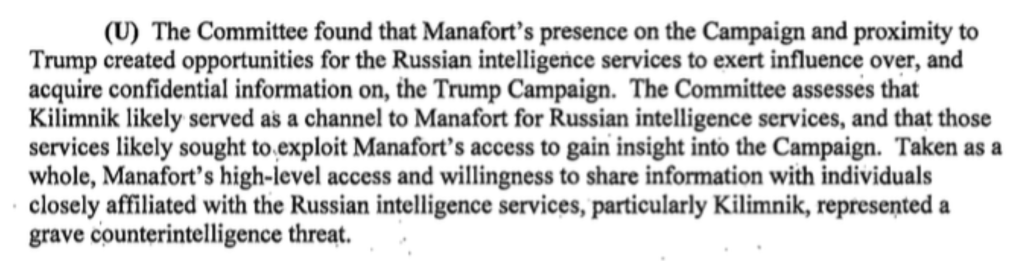
Trump’s campaign chair, Paul Manafort, posed a “grave counterintelligence threat.” Manafort shared secret campaign strategy and polling information with Russian Konstantin Kilimnik—remember that name—with whom he had formed a “close and lasting relationship” while working in Ukraine. “The committee found that Manafort’s presence on the Campaign and proximity to Trump created opportunities for Russian intelligence services to exert influence over, and acquire confidential information on, the Trump Campaign.” (Paul Manafort was convicted on eight felony counts in 2018.)
“Kilimnik is a Russian intelligence officer.” Kilimnik, mentioned over 800 times in the report, was also mentioned in the Mueller report as having ties to Russian intelligence. The Senate report goes further than Muller did, making clear Kilimnik was himself a Russian agent. And Trump’s campaign chair was secretly in frequent communication with him, sharing confidential information with him.
“Kilimnik almost certainly helped arrange some of the first public messaging that Ukraine had interfered in the U.S. election.” If you’re keeping track, this means that a Russian intelligence agent who was in close communication with the Trump campaign helped spread the false Ukraine story, which Trump tried to use to deflect blame from Russia. This alone is a vastly damning conclusion; in normal times it would constitute a massive scandal.
The Trump campaign used its relationship with Roger Stone to seek advance knowledge of when Wikileaks would drop hacked documents, and use them to Trump’s advantage. Stone was later convicted of seven felonies for witness tampering and lying to Congress about this very issue. But Trump commuted his sentence.
Trump lied in his written answers to Robert Mueller about Stone and Wikileaks. The president claimed he didn’t recall ever talking with Stone or anyone else about Wikileaks. But the (GOP-led!) committee says, “Despite Trump’s recollection, the Committee assesses that Trump did, in fact, speak with Stone about WikiLeaks and with members of his Campaign about Stone’s access to WikiLeaks on multiple occasions.” In fact, the campaign directed Stone to access inside knowledge from within Wikileaks regarding the timing of leak drops, which he did, and which he communicated directly to Trump.
At Trump’s request, Stone drafted at least 8 pro-Russia tweets for him in July 2016. Trump apparently really, really liked Russia and wanted to make a good impression on Putin.
Jay Sekulow (one of Trump’s personal attorneys) discussed a potential presidential pardon with Michael Cohen (a former Trump lawyer) multiple times after Cohen was indicted. Cohen testified the pardon idea had come from Trump through Sekulow. Dangling a pardon over someone who’s about to be put on trial for lying and doing other potentially illegal things for you? That’s a pretty big incentive to shut up and not cooperate with prosecutors. It’s also unethical as all get out.
The infamous meeting at Trump Tower, attended by Donald Trump, Jr. and Jared Kushner, was worse than we thought. It was “part of a broader influence operation targeting the United States that was coordinated, at least in part with elements of the Russian government.”“The committee assesses that at least two participants in the June 9, 2016 meeting…have significant connections to the Russian government, including the Russian intelligence services,” the panel concluded. “The connections the committee uncovered, particularly regarding Veselnitskaya, were far more extensive and concerning than what had been publicly known.” So, that’s the president’s son and son-in-law taking a meeting with at least two people with significant, extensive, and concerning connections to the Russian government, specifically in order to get dirt on another American and get him elected. But the FBI was supposed to ignore this, and investigating it was a made-up hoax. Okay.
The committee made criminal referrals of Donald Trump Jr., Jared Kushner, and Steve Bannon to federal prosecutors over their concerns that the three had misled the committee in their testimony. The referrals were made in 2019, but apparently no investigations ever happened.
The White House “significantly hampered and prolonged the Committee’s investigative effort.” The Trump administration did everything in its power to obstruct the Senate’s investigation. Donald Trump, Jr. ignored a subpoena until he realized the Committee was seriously considering holding him in contempt of Congress.
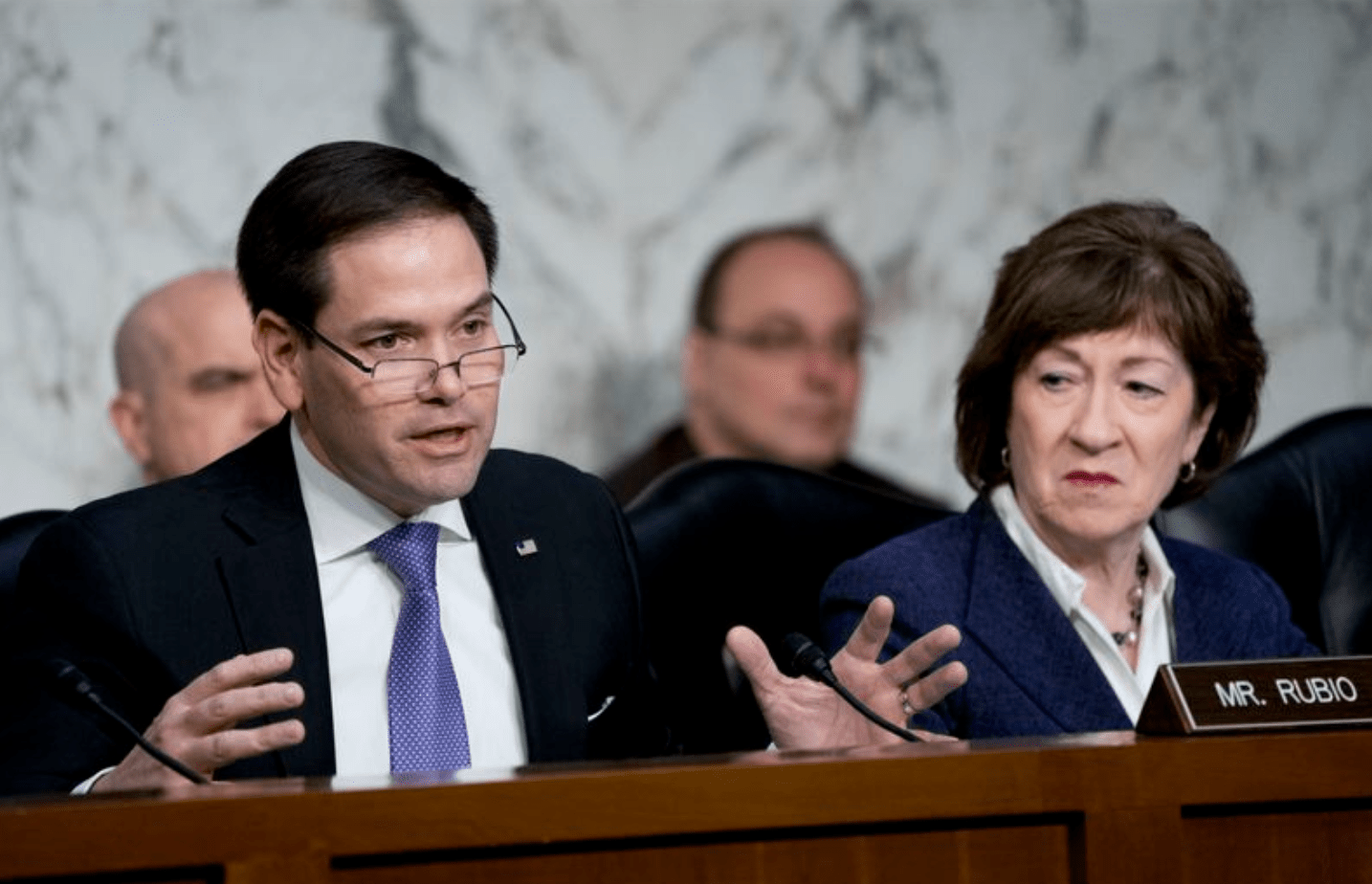
Committee Chair, Senator Marco Rubio, insists that they found no evidence of collusion. One wonders what exceedingly narrow definition of “collusion” the Committee used in order to come to that conclusion. Perhaps the same sort of tortured logic Senator Rubio employed when he insisted that even though the president had committed an impeachable offense, he shouldn’t be removed from office.
The Trump campaign eagerly sought and accepted help from Russians in our election, and actively shared confidential information directly with a Russian intelligence agent. At the very least, this report proves that the Russia investigation was no hoax. The president will never admit this, and his supporters will never believe it. But for anyone still open to the truth, this report makes it clear.
Update: Just since I posted this ten minutes ago, I learned that Steve Bannon has been arrested—by US Postal Service agents. (I admit: I did not know such people existed.) Bannon was Chief Executive Officer of Trump’s election campaign from August 2016, and afterword served as Chief Strategist in Trump’s administration until 2017. He is accused of defrauding donors to an online crowdfunding campaign called “We Build the Wall.”
In case you’ve lost count, that’s four Trump associates just in this article who’ve been arrested/convicted of felonies.
Now we come to it. I’ve known I’d have to write about this, and I’ve dreaded it. Normally, I’d say that who we vote for is personal, and nobody else needs to know. But I’ve been blogging about politics for the better part of a year now, and I felt it would be inauthentic to keep this decision to myself.
You all know, I’m sure, that my voting for Trump was never going to happen. In 2016, I voted for an independent candidate because neither Clinton nor Trump were acceptable choices. I rejected the “lesser of two evils” argument, partly because I found them both equally unacceptable, and partly because I wanted to cast my vote for a candidate, not just against another.
In the three and a half years since, Trump has continually shown me that I was right not to vote for him. I was convinced his performance as president would be bad, but I could never have predicted how abysmal, how shockingly, insanely bad it has turned out to be. His few conservative policy wins have not outweighed his many anti-conservative ones, and certainly not his erratic, counterproductive, self-serving mode of “leadership.”
I worried back then that a man like Trump would reflect poorly on the GOP, that his vices and low character would become synonymous with “Republican”—or worse, with “conservative” (even though he is nearly the polar opposite of a conservative.) I should have worried harder. Not only have his vices and low character continued and expanded, they’ve been excused, defended, and in many cases adopted by virtually the entire party.
By the time the impeachment trial was wrapping up, I was questioning whether I had been proven wrong in not voting for Hillary. Hear me out, conservatives. I don’t believe she would have been a good president. I share your visceral dislike and distrust of her. But if she had won, the party wouldn’t be in this mess. The Republican president wouldn’t bear the shame of impeachment. We wouldn’t have watched Republicans debase themselves by defending him with claims that were proven false over and over. We wouldn’t have seen a slew of Republican Senators admit that their leader had abused his power, and then vote to acquit him anyway. The entire Republican party would not now carry the stain of excusing Donald Trump’s inexcusable behavior over the course of this presidency. I’m convinced the party would be in infinitely better shape today if Hillary Clinton had won.
In early 2020, though I knew I wouldn’t vote for Trump, I still wasn’t sure who I’d vote for.
Then came the virus.
I watched the denial and dysfunction in Washington, watched the disease spread, watched the death toll rise, and suddenly, everything became very simple.
There has to be an adult in charge.
Before the virus, it was just politics. It was weighing principles against policies, and judges against moral judgments. Now, it’s life and death.
The pandemic made evident how very influential the President of the United States is, and how cataclysmic the results can be if the person in office is unfit to lead. We can’t keep a tantrum-throwing mantoddler at the wheel. Lives are at stake.
I keep hearing from Republicans and evangelicals that this is the most important election of our lifetimes. I’ve been hearing that about every election since 2000, but for once, I think they’re right. We can’t take four more years of this. The damage has already been too great, both to the GOP and to the nation.
I have never voted for a Democrat in my life.
I’m voting for Joe Biden.
I know this will strike my conservative readers as a betrayal. Please know I have agonized over this decision. Please allow me to explain my position.
The Republican Party has aggressive, stage four cancer. It has metastasized throughout the party. From the local level on up, the GOP is riddled with it. It will be fatal to the party unless something drastic changes.
Chemotherapy sucks. Nobody enjoys it. It makes you feel sick—often sicker than the cancer did. It’s basically poison, and it does some collateral damage to healthy parts of the body while it’s killing the cancer. But doctors prescribe it and patients take it because it’s better than dying.
Trumpism is the cancer. Biden is the chemo.
More accurately: an unequivocal electoral rejection of Trumpism is the chemo. Trump and his enablers need to be annihilated at the polls. The Republican party must pay so dearly for having embraced Trumpism that it never dares to do so again. That’s the only way for it to survive in any useful form.
Please understand this: I want the GOP to survive. We need (at least) two healthy, functioning political parties in this country to balance one another and represent Americans on both the left and right. We need a party that will hold back government overreach and keep taxes reasonable and vigorously defend the Bill of Rights.
But that party must have integrity. It must be trustworthy. It has to put the Constitution above any individual. The GOP has utterly abandoned truth, justice, and common sense in service to Donald Trump.
The party is full of cancer, and it needs chemo.
I disagree with Joe Biden on almost everything, policywise. Just one example: he supports California’s AB 5 law, which is ruining the livelihoods of a lot of freelancers, and which, if adopted federally, could probably bankrupt my family. But he is an adult. He is experienced. He has consistently displayed humanity and empathy—no one can make a compelling argument that he’s a malignant narcissist or a sociopath—and this alone makes him a far better choice than Donald Trump.
There are legitimate reasons to question my decision. I can hear many of you already. Let me address some of your rebuttals right now:
“But socialism!” Yes, the left is leaning more and more toward Marxism, and many don’t even hide it anymore. I’ll be honest: if Bernie had won the nomination, I wouldn’t be writing this article. I could not have brought myself to vote for a self-proclaimed socialist. Biden is not a Marxist. He may be left of us, friends, but he’s not a Marxist. Heck, just ask a Bernie bro how they feel about Biden. They hate his guts; he’s too centrist.
“What about Tara Reade?” I looked into her claims that Biden sexually assaulted her. If her accusations were believable, they would have been disqualifying. I don’t believe her.
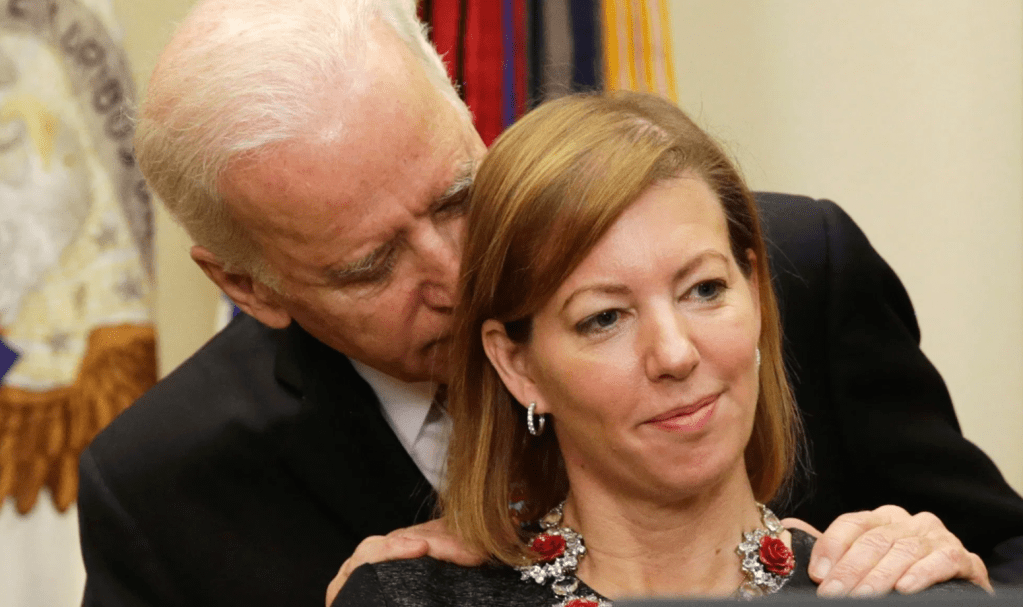
“What about the hair-sniffing?”
Joe Biden does have a long habit of apparently invading the personal space of women and girls, and a Nevada assemblywoman says he made her feel uncomfortable when he smelled her hair and kissed the back of her head. I won’t offer a defense of this behavior. He ought to knock it off. I will say that if you believe this makes him unfit to be president, then I have some very bad news for you about Donald Trump. (Also, for the record, the woman in this photo calls Joe Biden a “close friend” and defends him.)
“What about Hunter Biden?” Biden’s son, Hunter, got kicked out of the Navy for using cocaine, divorced his wife to date his own brother’s widow, only to knock up another woman. He’s taken lucrative positions that were apparently bestowed on him solely due to his father’s prominence in the US government. Hunter Biden sounds like a real dirtbag. I’m definitely not voting for him.
“Isn’t he going senile?” Joe Biden has dropped some head-scratchers. And at 77, he’s no spring chicken. But he has struggled with a stutter since childhood, which can make some of his verbal blunders appear worse than they really are. And he has admitted he is a “gaffe machine.” I’m not going to ascribe to dementia what can be adequately explained by age and a stutter.
“What about abortion?” This one gave me more pause than all the rest combined. One of the reasons I’ve never voted for a Democrat is that I couldn’t justify giving my vote to someone who would advance abortion. (Many on the left believe conservatives oppose abortion because of a perverse desire to control women’s bodies. They are wrong. We believe abortion kills a unique and innocent human being, and therefore we oppose it.) I didn’t want to support any candidate who would hurt the pro-life cause. But I’ve come to believe that abortion is a spiritual and cultural issue more than a political issue. I didn’t learn until earlier this year that the number of abortions in the US has dropped every year since the Carter administration. It didn’t matter whether a Republican or Democrat was in office. Pro-life groups can make a much bigger difference by continuing to provide support for moms and babies than by voting for or against politicians.
(Also, I’ll note that under Trump, Republicans held the White House, the Senate, and the House for two years, and Planned Parenthood is still getting our tax dollars.)
Some of my pro-life friends will vehemently disagree. I understand. Unborn lives matter. But they are not the only lives that matter, and other lives are on the line, too; and as I noted, abortions are steadily decreasing regardless of who occupies the White House.
“Aren’t you flip-flopping by choosing the lesser of two evils now, after refusing to do that in 2016?” I suppose someone could make a pretty strong argument for that, yes. My defense is this: Joe Biden is not Hillary Clinton, and Donald Trump has proven to be the most corrupt, incompetent, and unfit president in modern history. He has to go.
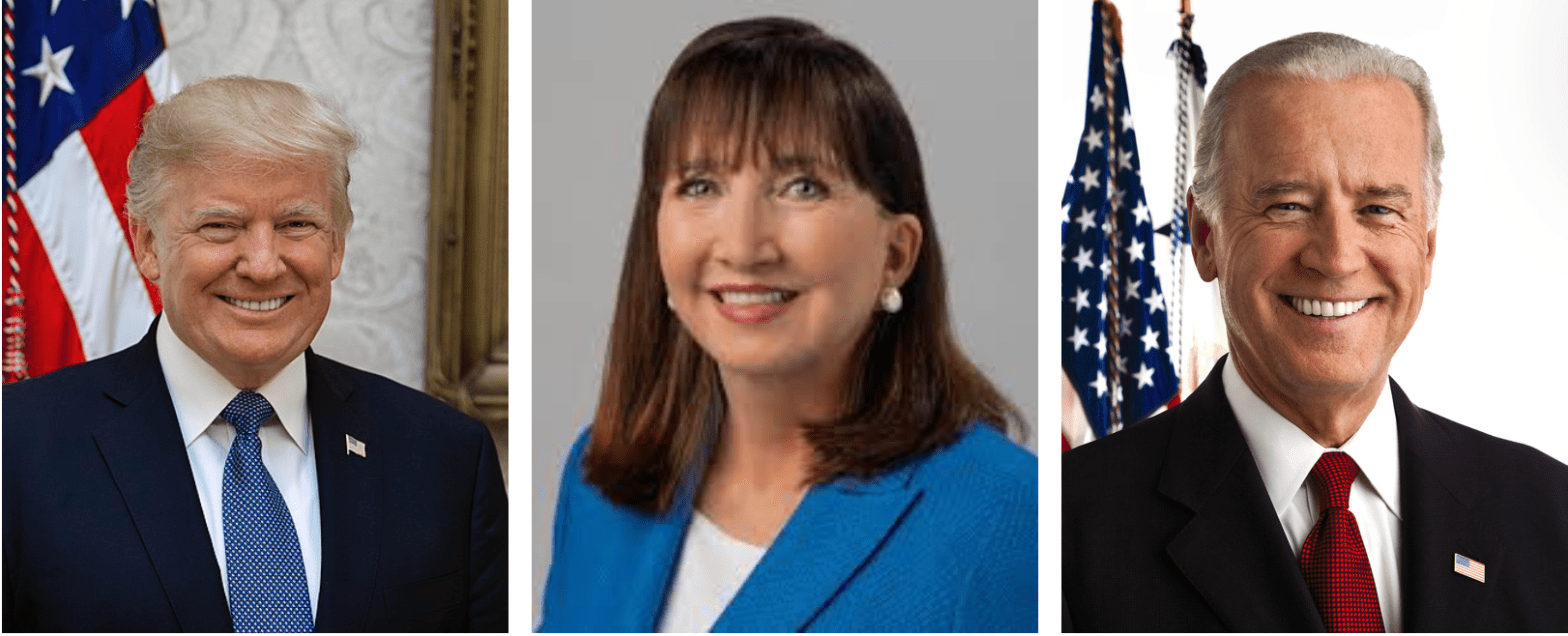
“Why not vote third party?” I wish I could—really, I do. The two party system is failing us. I hope I live to see it change. The Libertarian Party is running Jo Jorgensen, and honestly, most of her platform makes me feel all warm and tingly inside. If I thought she had any chance, this might be a very different article. In 2016 I did vote third party. But remember, my sole goal this year is to stop America’s bleeding and save the GOP by curb-stomping Trumpism. A third party vote won’t run up the score against Trump and his enablers. The cancer has spread too widely for me to adopt a “wait and see” strategy. We need chemo, stat. Also, if I were to vote third party and then Trump won reelection, I would feel guilty about it forever.
“Won’t he wreck the economy?” Conservatives rightfully fear Democrat rule due to their insatiable hunger for bigger federal programs requiring government expansion and massive tax hikes. Friends, I hate to be the one to tell you this, but the economy is already wrecked. The good news is he’ll have his hands full trying to get it up and running smoothly again, and his more progressive goals will likely take a back seat. Don’t take my word for it: that’s what JPMorgan thinks.
“If Biden wins, America will be destroyed.” People keep telling me that if Joe Biden wins, America will be destroyed. (I’m not exaggerating; word for word, this sentiment is everywhere on the right.) It sounds really scary. How will he end America, I wonder? By running up the deficit past a trillion dollars? By growing the national debt by trillions and trillions of dollars? Maybe he’ll start a costly trade war with China. Or use the power of his office to threaten private companies and attack individual Americans. Will there be mass unemployment? Citizens rioting in the streets? Ruthless government crackdowns on peaceful protestors? Will he throw gasoline on the flames of racial tensions by defending the Confederate flag? Will he accomplish America’s destruction by alienating and abandoning our allies? Or by heaping praise on the world’s worst tyrants? Will he convince millions of citizens that the free press is their enemy, so that they become incapable of distinguishing facts from lies and conspiracy theories? Perhaps he’ll mismanage things so epically that most of the countries in the world will see the US as a disease-ridden pariah and ban Americans from entering. Will he focus more on his reelection prospects than Americans dying by the tens of thousands? Perhaps he’ll destroy America by arguing that a president is above the law, and abusing his office. Maybe he’ll even have the audacity to claim that his authority as president is total. I’ll bet his party will fall in line as he does all of these things and more, and refuse to hold him accountable.
Truly, this is a horrifying thought. Can you even imagine such an America?
We should definitely do whatever it takes to stop this.
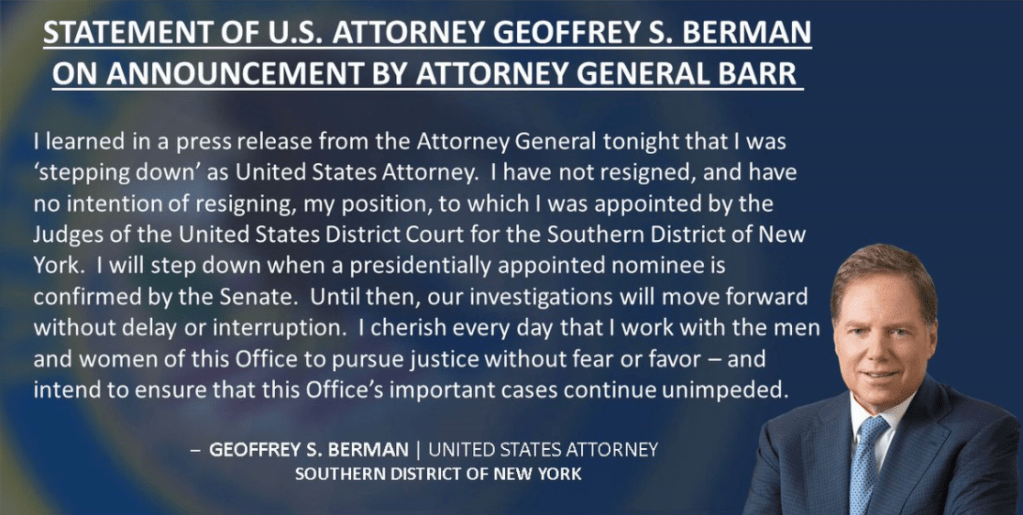
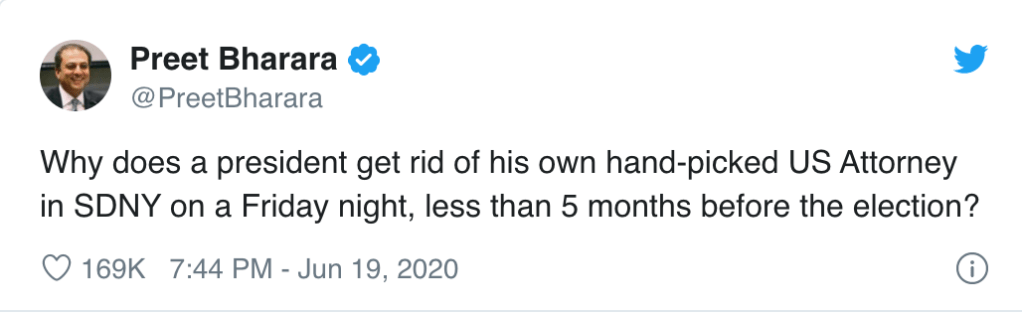
In a move that’s drawn inevitable comparisons to Nixon’s Saturday Night Massacre, Attorney General Bill Barr issued a press release after 9 pm on Friday night, announcing the replacement of the US Attorney for the Southern District of New York. “…I thank Geoffrey Berman, who is stepping down after two-and-a-half years of service as United States Attorney for the Southern District of New York.”
In a surreal turn of events, an hour later, Berman released this statement:
This exchange is understandably rocking Washington. There is a lot going on in this story. Let me try to break it down for you:
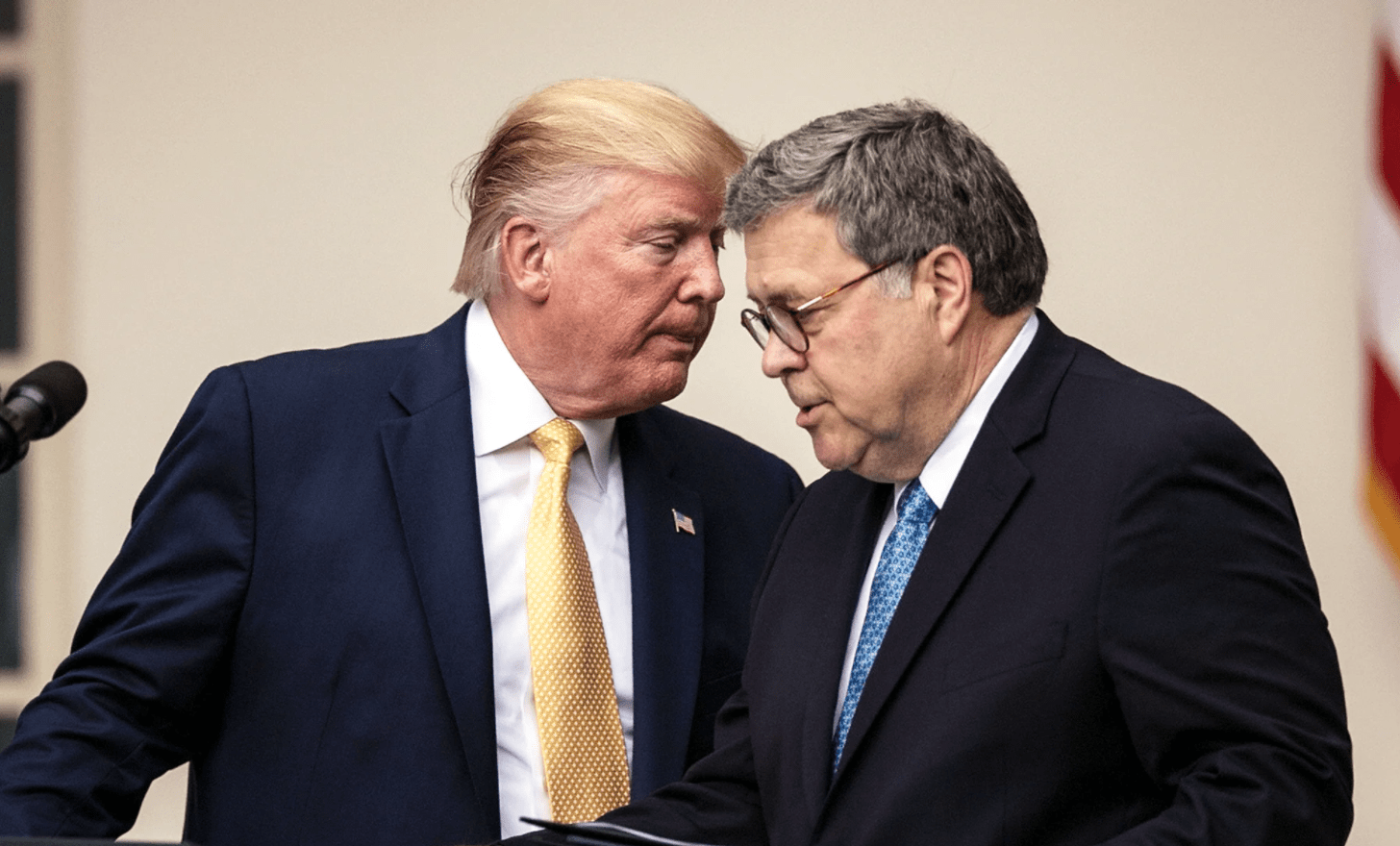
First, you need to understand Attorney General Bill Barr. He is a man who has consistently used his power as head of the Justice Department to protect the president’s political interests and to shield him and his associates from legal consequences. Examples:
The widely-held belief among Republicans that the Mueller report totally exonerated Trump comes not from the actual report, but from AG Barr’s letter to Congress, summarizing the not-yet-released report. Based on Barr’s letter, media reported that the investigation found no collusion and no obstruction of justice, when in fact, the report found considerable links between the Trump campaign and Russia, and strongly suggested the president had obstructed justice. But it was too late. The narrative had been established by the AG, and for millions of Americans, it remains unalterable fact. But in March of this year, a federal judge—a George W Bush appointee—excoriated Barr for his handling of the Mueller report. Barr’s inconsistencies, the judge writes, “cause the Court to seriously question whether Attorney General Barr made a calculated attempt to influence public discourse about the Mueller Report in favor of President Trump.” The judge concurred with Special Counsel Mueller that “Attorney General Barr distorted the findings in the Mueller Report.”
Federal prosecutors recommended a sentence of 7-9 years for Roger Stone, a Trump associate who lied to Congress about his contacts with Wikileaks during the 2016 election. The president tweeted angrily about the unfairness of such a sentence for his longtime ally, and the very next day, the DOJ undermined the prosecutors by filing a revised recommendation, asking for far less prison time for Stone. Four prosecutors quit the case, and one of them resigned entirely. Over 1,000 alumni of the Justice Department signed a letter calling on Barr to resign over this incident, saying, “Governments that use the enormous power of law enforcement to punish their enemies and reward their allies are not constitutional republics; they are autocracies.”
In May, in a stunning about-face, Barr’s DOJ moved to drop charges against Michael Flynn, Trump’s first National Security Advisor. Flynn had already twice admitted under oath that he had lied to the FBI about his contacts with Russia. Faced with this unprecedented request, Judge Sullivan selected a former judge, John Gleeson, to weigh in. After reviewing the case, Gleeson blasted Barr and the DOJ, calling their claims “preposterous” and accusing them of “gross abuse of prosecutorial power.” He called the request “an unconvincing effort to disguise as legitimate a decision to dismiss that is based solely on the fact that Flynn is a political ally of President Trump.”
That’s who Bill Barr is. That’s who lied to you and me about Berman stepping down. So, the obvious question is: why? Why does Barr (read: Trump) want to be rid of US Attorney Berman? Planning to replace him, by the way, with Jay Clayton, Chairman of the Securities and Exchange Commission, who has never been a prosecutor?
We can’t know for sure, but I have a few guesses.
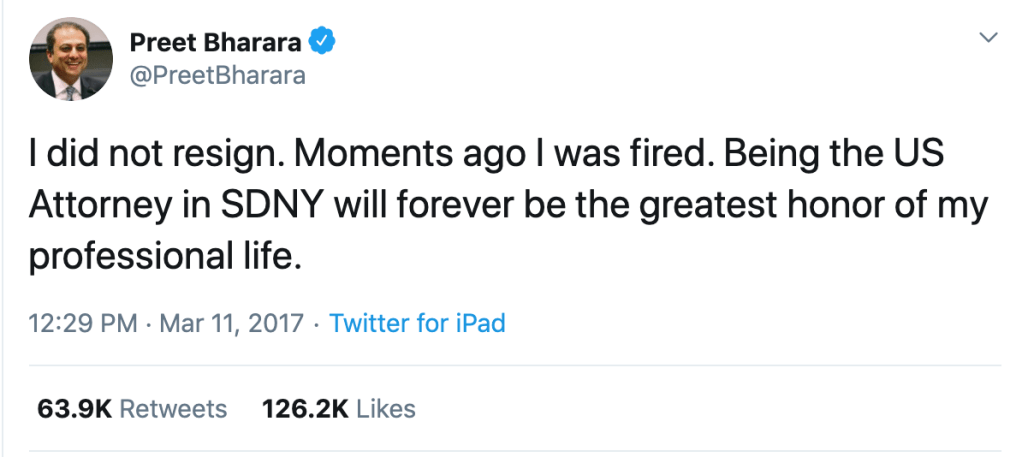
First let’s talk about how Berman got the job. In November of 2016, US Attorney Preet Bharara had been in charge of the SDNY for seven years. He was asked by the president-elect to stay on in the position, and he agreed. On March 8, an ethics watchdog group sent him a letter, urging him to investigate Trump for potential violations of the Emoluments Clause—financial conflicts of interest due to his business ventures in foreign countries. Three days later, Trump fired him.
I can’t say conclusively that the events are linked, but it’s a fact that they occurred, and on that timeline.
In January of 2018, then-Attorney General Jeff Sessions appointed Geoff Berman as interim US Attorney for the SDNY. Berman was a Republican—a Trump donor—and his appointment was opposed by Senate Democrats. US Attorneys are supposed to be chosen by the president and confirmed by the Senate. But Trump left several US Attorney positions—including the SDNY—unfilled for so long that in Berman’s case, federal judges took advantage of a seldom-used power to make Berman’s position permanent, one week before his 120-day term was set to end. As explained in this 2018 article, under federal law, Berman is to serve as US Attorney until Trump nominates and the Senate confirms his replacement.
Which would seem to indicate that Barr does not have the power to force Berman out, as he does with most US Attorneys. This sets up an explosive battle between the DOJ (the executive branch) and the Southern District of New York.
But again, the question is: why does he want to force him out and replace him with a man who has never served as a prosecutor?
Why make a move like this, which is sure to draw scrutiny?
Again, all I have are guesses. Much like Trump’s tax returns, I have to assume that whatever he’s hiding is worse than the heat he’ll take for hiding it.
Berman’s SDNY prosecuted Trump attorney Michael Cohen, who pleaded guilty to eight felony counts and was sentenced to three years in prison. In court, while pleading for leniency, Cohen told the judge, “My weakness could be characterized as a blind loyalty to Donald Trump.”
Berman’s SDNY is conducting an ongoing investigation of Trump’s personal attorney and longtime ally, Rudy Giuliani. It has already brought charges against Giuliani’s associates, Lev Parnas and Igor Fruman, who were involved in the Ukraine scandal that led to Trump’s impeachment.
It’s been reported that the SDNY is investigating Deutsche Bank for suspected money laundering. Deutsche Bank has long been reported to have loaned billions of dollars to Trump companies.
After the death of Jeffrey Epstein, Berman affirmed that the SDNY would continue its sex-trafficking investigation into the conduct charged in his indictment. Donald Trump’s (and Bill Clinton’s) connections to Jeffrey Epstein are well-known.
Read Berman’s statement again. He twice emphasizes that his investigations will continue. Reading between the lines, the investigations are what he’s trying to protect, and Barr is trying to stop.
No one knows yet who will win this standoff. But it’s a safe bet that the pattern of Trump and Barr subverting justice will continue until they no longer have power to do so.
UPDATE: I wrote this article on Saturday the 20th. Since then, Barr wrote a public reply to Berman, telling him, “Because you have declared that you have no intention of resigning, I have asked the President to remove you as of today, and he has done so.” (Apparently, though the AG does not have the power to remove a US Attorney appointed by judges, the president does.) However, when asked why he’s firing Berman, the president said it’s all up to Barr, and denied any involvement.
Berman, therefore, probably could have fought his ouster longer, but he has decided to leave immediately, and there seems to be one reason why. In Barr’s original press release, he said that Berman’s interim successor would be Craig Carpenito, current USA for New Jersey. With Berman being fired rather than stepping down, now his interim replacement must be his own Deputy US Attorney, Audrey Strauss. Berman says of Strauss, “She is the smartest, most principled, and effective lawyer with whom I have ever had the privilege of working.”
The House Judiciary Committee has opened an investigation of this matter.
By now we all know what happened: a white police officer knelt on the neck of a black man, George Floyd, for minutes on end while George begged for air and a watching crowd pleaded for his life. Eventually, George stopped moving. He stopped begging for air. They called for an ambulance, but the officer didn’t take his knee off of George’s neck until the medics arrived. He was pronounced dead at the hospital.
The next day, this is how a police spokesman described the event to reporters: “Officers were able to get the suspect into handcuffs and officers noticed that the man was going into medical distress.”
Here are some things you may not know. Knee-on-the-neck restraint is banned by several major police departments because of the high risk of injury. Minneapolis only allows it when the suspect is resisting arrest, which, based on the video we’ve all seen, George was not.
The officer who killed George Floyd, Derek Chauvin, had 18 prior complaints filed against him. Eighteen. Of those, two were “closed with discipline.” The discipline he received? Letters of reprimand. One of the other officers was the subject of an excessive force lawsuit in 2017 which the city settled. The lawsuit alleged that two officers had punched, kicked, and kneed the plaintiff in the face and body while he was handcuffed and defenseless.
Derek Chauvin killed George Floyd in the street, on camera, in front of witnesses. He was fired, but as I write this five days later, he is still a free man. I’m no law expert, but I have to wonder: if his actions which killed a man were so clearly wrong that he could be quickly fired, why hasn’t he been arrested? The mayor of Minneapolis has asked the same question, but Chauvin is still walking around free.
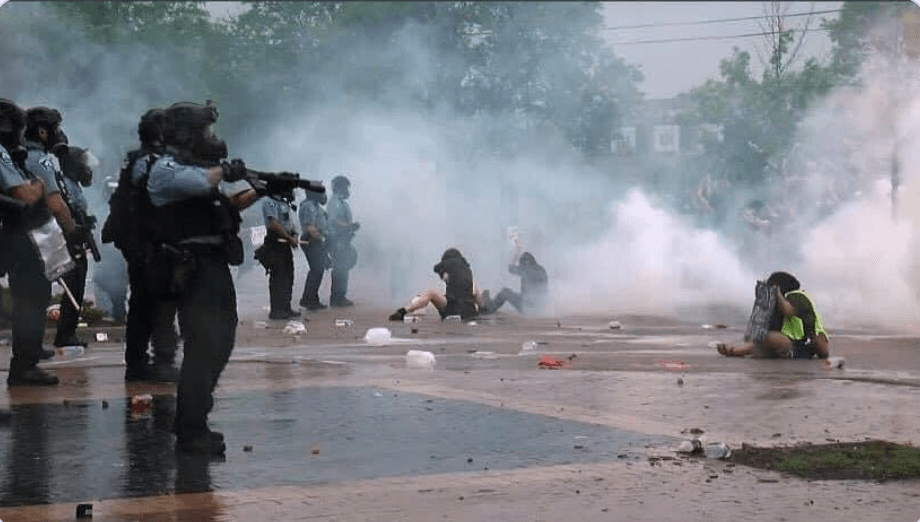
On Tuesday night, hundreds of protestors marched to the police precinct to demand justice for George Floyd—whose killer, I will remind you, was a free man more than 24 hours later. Some protestors damaged windows and a squad car, and sprayed graffiti on the building. The department responded by sending a line of police in riot gear to shoot tear gas and rubber bullets at them.
“So far, I have been unable to prevent the police from firing indiscriminately into the crowd,” city council member Jeremiah Ellison said. “Moments ago, I held a towel to a teenage girl’s head as blood poured from it.”
Since then, the riots have worsened and spread, with many fires set and businesses looted. Let me say here for the record that I don’t condone looting, nor damaging private property. It’s counterproductive, violates the rights of private citizens, and gives ammunition to those who would prefer for police to never be held accountable.
But.
What else do we expect?
I noticed this paradox in conservatives several years ago. Yes, we believe in law and order, but first and foremost we believe in limited government and individual liberty. We passionately defend the second amendment, not because we believe we have a sacred right to hunt, and not even primarily to defend ourselves against individuals trying to harm us. We have always believed that the founders intended our right to bear arms to protect us from an oppressive or tyrannical government—indeed, this right was meant to keep the government from ever becoming oppressive or tyrannical. We believe our government should have a healthy fear of angering us. That’s why citizens showed up like this at Michigan’s capitol to protest lockdowns they see as infringing on their liberty:
Conservatives care deeply about keeping the government limited, and preserving individual liberty.
Yet when government power is wearing blue, many of them seem to think it should be unlimited.
What greater expansion of government power can there be than the power to kill American citizens with impunity? What greater infringement of individual liberty can there be than being killed in the street by one’s own government, deprived of any due process?
When American colonists got fed up with their government infringing on their freedoms, they destroyed state property. They vandalized stores. They formed militias. They rioted. They fought back.
Most conservatives I know don’t have a problem with any of that. They’re big fans, actually.
But based on what I’m seeing now, many of today’s conservatives have a bigger problem with frustrated and infuriated citizens fighting back in the only ways they feel they can than with agents of the state getting away with murdering citizens in the street.
Fellow conservatives: let me suggest we reevaluate our priorities.
If we don’t want to see riots, if we don’t want citizens to resort to violence and property damage in defense of their rights to life and liberty, we should demand that our government do better. We must demand our police do better. We must hold them to a high standard and stop making excuses for the bad ones in order to protect the good ones. Otherwise, what do we expect? How long do we expect American citizens to passively accept government oppression?
An officer of the state deprived George Floyd of due process, deprived him of dignity, and deprived him of his most foundational right as a human being: his right to life. The state did not hold their officer accountable, so George Floyd’s fellow citizens burned that police precinct to the ground.