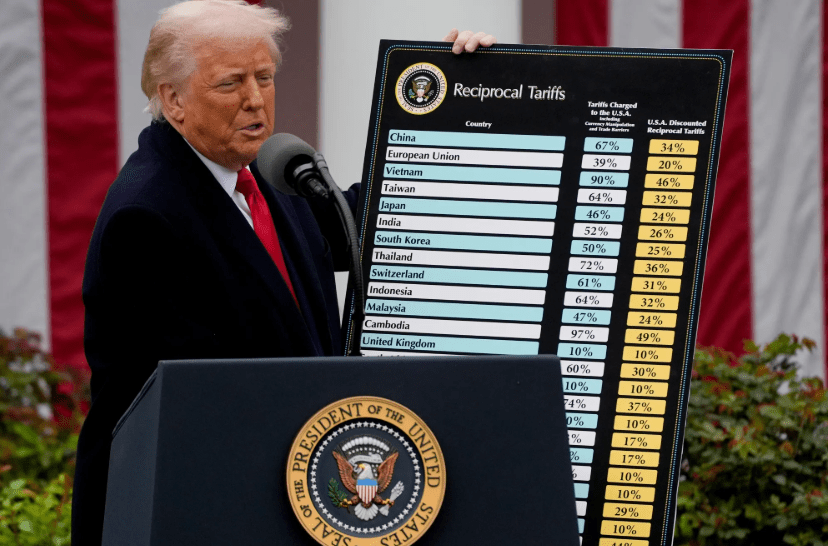
Trying to narrow down this topic into a single, coherent article has been a massive challenge, but I’ve done my best. Here are the keys to understanding what the president believes, what he’s doing, and why he’s wrong.
“America is getting ripped off.”
Trump has believed this for decades. In 1987 he took out full-page ads in various newspapers to complain about Japan and what he viewed as their unfair trade practices. He has long claimed that NAFTA was bad for America, so he killed it in his first term, replacing it with his own trade deal, USMCA (which he violated in February when he imposed broad 25% tariffs on Canada and Mexico.)
The simplest and clearest explanation of the president’s views on international trade comes from 2018, when he was returning from the G20 summit, editing a speech. He scribbled three words on the page: “Trade is bad.”
That view is so manifestly incorrect that I won’t waste any space in this article to contradict it.
Here is the most crucial key to understanding his stance: He believes any trade deficit is evidence that we’re being ripped off.
I’ll explain this more soon, but first I want to be sure you understand what a trade deficit is—because let’s be honest: it sounds like a bad thing. It’s very simple: if we buy more from another country than they buy from us, we have a trade deficit with them. For example, I have a massive trade deficit with my grocery store. I’ve bought thousands of dollars’ worth of products from them over the years, and they have bought absolutely nothing from me. But does it follow that I’m being treated unfairly? Of course not.
More relevantly: we import lots and lots of stuff from Vietnam—Americans like buying affordable things made by people who earn $290 per month. Vietnam buys stuff from us too, but they buy less from us than we do from them, understandably. But apparently not understandably if you’re Donald Trump; he believes they’re treating us unfairly. More on this later.
“Foreign countries pay the tariffs.”
Trump has insisted this over and over for years, and he is just as wrong today as he was in his first term. Tariffs are import taxes paid by the importer. My kids learned this in 6th grade social studies. A conservative legal group believes he’s so wrong they are suing him. He is just plain wrong.
Or is he lying? In a conference call in March, the president warned US automakers not to raise prices in response to his upcoming tariffs. But why did he feel it was necessary to issue such a warning? If foreign countries pay the tariffs as he claims, why would American car manufacturers need to raise prices? (Read the linked article if you need more proof that his tariffs will force them to raise prices significantly.)
As far as understanding why the President of the United States would stubbornly and publicly cling to such a demonstrably false idea despite being told hundreds of times that he’s wrong, I’m afraid there’s really only one explanation that makes any sense: he has textbook narcissistic personality disorder, and when a narcissist is proven wrong, they double down. If anyone has a better explanation, I’m all ears.
“These are reciprocal tariffs.”
This one is a doozy, and if you want a really thorough explanation of how the administration came up with the “reciprocal tariff” rates unveiled on April 2, here is a very good resource.
In a nutshell, here’s what to understand about Trump’s “reciprocal” tariffs announced last week:
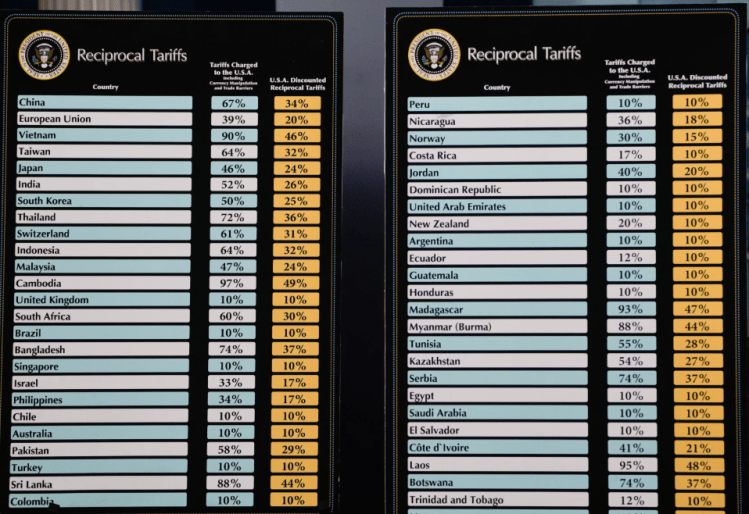
The poster’s title of “Reciprocal Tariffs” and the column heading “Tariffs Charged to the USA” are simply false. Even the fine print, “Including Currency Manipulation and Trade Barriers” is false. Economists figured out, and the White House confirmed, that the “Tariffs Charged to the USA” figures were calculated not by calculating tariff rates plus trade barriers as claimed, but by dividing our trade deficit with that country by that country’s exports to us. For countries whose calculated rates were under 10%, he set the rate at 10% across the board.
So, these “reciprocal tariffs” have absolutely no relation to tariffs imposed on us. They are a completely made-up measure of “cheating” as declared by Donald Trump.
This is how he ends up claiming that Vietnam, a country which spends 3% of its GDP buying goods from America, actually charges 90% tariffs on the US: because although we spend only 0.49% of our GDP on goods from Vietnam, the dollar amount is less and therefore, they are cheating us. His chart shows that he really believes a nation less than one-third of our population and 64 times poorer ought to be buying every bit as much from us as we buy from them. And because they haven’t been, he will now punish them. (That’s his intention; but recall that the tariffs will in fact be paid by Americans.)
“It’s hard to state just how nonsensical that actually is,” one columnist writes. “You might as well divide the numbers of apples in your kitchen by the number of bagels and use it to calculate your mortgage rate. To criticise it on political or economic grounds is too generous. It operates below the level of rational thought.” When you consider that his “Liberation Day” announcement also levied tariffs on islands solely inhabited by penguins and an island that’s home only to a joint military base populated entirely by US and British troops with no exports to speak of, it’s hard to argue.
We’ve been “looted, pillaged, raped, and plundered…”
In his now-infamous Rose Garden address, he claimed this is what’s been done to the United States by “friend and foe alike.”
It’s an interesting way to describe the richest nation in the history of the world. If we’re so oppressed, how have we managed to consistently have the largest GDP of any country on the planet? A country so impressively dominant that there’s not a close second? (Our GDP is 64% larger than second-place China.) If we’ve been constantly “pillaged” by our trade partners, why is the value of our goods and services 50% higher than every country in the European Union combined?
If American companies have been “plundered” by other nations, then why is it that WalMart—which is only the tenth most valuable company in the US—would be the 22nd richest nation in the world if it were a country? If we have been “raped” by the rest of the world, then why could dozens of countries combine their worth and still not rival the value of Apple? Why is Illinois as valuable as the entire nation of Turkey?
As pillagers go, they seem pretty incompetent.
“This will be the Golden Age of America.”
He says his tariffs will bring the Golden Age of America, but markets, economists, history, and high-profile Republicans beg to differ.
America has spent decades dismantling trade protectionism, ever since the failed Smoot-Hawley tariffs of 1930. And those decades have seen the largest number of people lifted out of poverty in all of human history. With his tariff announcements on April 2, Trump did an abrupt 180 on American trade policy.
Trump’s Secretary of the Treasury, Scott Bessent, says the new tariffs could bring in anywhere between $300-$600 billion in the next year. Even if they perform to his highest estimates, in one year the tariffs will recoup 12% of the market value wiped out in 48 hours by Trump’s tariff pronouncement. It’s hard to see how the Golden Age of America can be commenced by vaporizing $5 trillion of American wealth in two days.
It’s unclear how driving South Korea and Japan directly into China’s arms will aid America. No one has explained how angering and alienating virtually every ally we have will improve America’s standing in the world.
JP Morgan’s Chief Global Strategist says, “The trouble with tariffs, to be succinct, is that they raise prices, slow economic growth, cut profits, increase unemployment, worsen inequality, diminish productivity and increase global tensions. Other than that, they’re fine.”
The Economist says, “Donald Trump has committed the most profound, harmful and unnecessary economic error in the modern era. Almost everything he said—on history, economics and the technicalities of trade—was utterly deluded.”
While the stock market line plummets, the likelihood of global recession line is climbing steeply—now as high as 60% thanks to these tariffs.
JD Vance tweeted in 2017: “Can’t be repeated enough: if you’re worried about America’s economic interest, focus more on automation/education than trade protectionism.”
Mike Pence tweeted on April 2: “The Trump Tariff Tax is the largest peacetime tax hike in U.S. history…and will cost American families over $3,500 per year.”
Bill Ackman, billionaire and diehard Trump supporter, tweeted on April 6 that if Trump follows through on implementing these tariffs, he will be launching “economic nuclear war on every country in the world,” and “destroying confidence in our country as a trading partner.” He says that small businesses and low-income Americans will suffer the most as a result, and that the consequences for our country will be “severely negative.”
Ronald Reagan, a year after Donald Trump took out those full-page ads calling for trade protectionism, had words for men like him: “Our peaceful trading partners are not our enemies; they are our allies. We should beware of the demagogues who are ready to declare a trade war against our friends—weakening our economy, our national security, and the entire free world—all while cynically waving the American flag.”
What we can do:
The Constitution explicitly grants Congress the power to regulate foreign commerce. In 1977 Congress passed a law that allows the President special powers to levy tariffs during a national emergency. Trump used this law to declare a national emergency and impose his tariffs—the first President ever to do so.
Congress delegated this power to the President, and they can revoke it. Congress can reclaim its Constitutionally-bestowed power and put a stop to these tariffs at any time.
Let’s make sure our representatives know we want them to take their power back and fix this, now.
 Wilderness Dispatch
3 thoughts on “Understanding Trump and his Tariffs”